
Beijing is scratching the barrel for social-security fixes
A nationwide crackdown on under-reported wages will raise costs for employers and cut take-home pay for workers at the same time. That is not the way to fix consumer confidence.

Dragonometry is now behind a paywall: $25/month or $200/year for individual subscribers, with a 30-day free trial for new subscribers and 30% off group plans of three or more seats ($175/seat/year). Read our thesis on US-China relations here and check out our weekly deep dives here.
In today’s Daily Dragon: Beijing is tightening enforcement on social security contributions, a fix that arrives years late and risks hammering consumer confidence and private-sector investment at the same time; China’s inflation data revives deflation risk as the Iran-war oil shock fades; rare earths become a three-government tug of war; Hong Kong’s Northern Metropolis deepens the city’s pull back toward the mainland; AgiBot dethrones Unitree as the world’s top humanoid-robot maker days before Unitree’s IPO is oversubscribed 5,526 times over; and CATL’s flying-car battery breakthrough sits next to a lithium mine that’s been shut for a year.
Today we also introduce Views from Substackland, with a collection of six independent analysts who weigh in on everything from Japan’s debt to Tesla’s China problem, while GeoLinks runs wide today: tariff refunds flowing back to Chinese firms, Beijing’s financial-governance push, Korea and Japan, Taiwan, and a fresh China-India border spat.
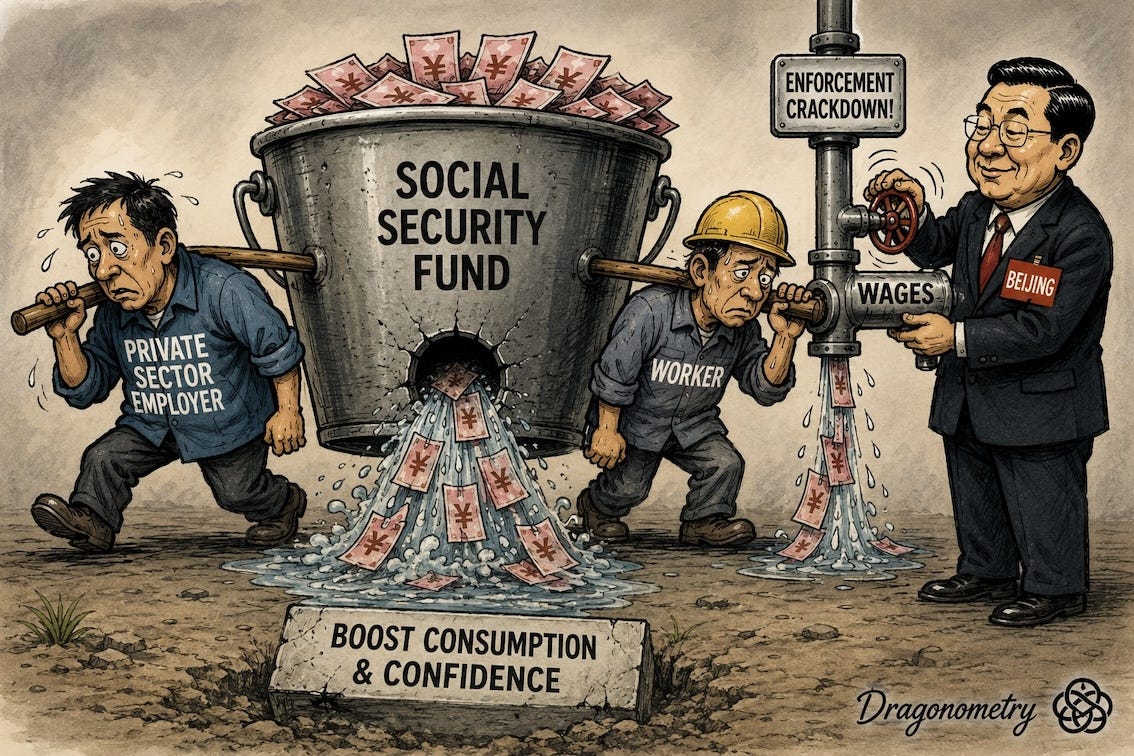
BEIJING IS TIGHTENING enforcement on social security contributions, which is arguably what it should have done many years ago. Doing it now, however, is a classic case of closing the stable door long after the horses have bolted. It will likely only further depress consumer confidence and, worse, hammer private-sector investment at the same time. This is what happens when a government denies that it has a rebalancing problem that requires real demand-side reforms to address.
For years, employers across China have based payments into pension, medical and unemployment funds on wages far below what workers earn. It was a quiet, widely tolerated shortcut that lowered labor costs for businesses and, not incidentally, kept take-home pay a little higher than the official base would suggest. The crackdown ends that. Contributions now have to reflect actual wages. Caixin’s reporting frames it as a straightforward compliance fix. It is also, unavoidably, a simultaneous tax rise on employers and a pay cut for employees, arriving at the exact moment Beijing says it wants households to be spending more.
No one doubts this is a tough dilemma. China’s social security funds need topping up: the unemployment insurance fund is running a deficit as benefit payments climb, and corporate pension shortfalls are widening as the workforce ages faster than contributions grow. There are two ways to fix a funding gap like that. One is to grow the pool of resources available to fill it, through fiscal transfers, higher state contributions, and a genuine shift of national income toward households. The other is to squeeze harder on the base already paying in. Beijing has chosen the second, which reveals something the rhetoric does not: a leadership that talks about consumption-led rebalancing while reaching, when a bill comes due, for the tool that suppresses consumption further.
Michael Pettis has made this argument for years, in different forms, applied to different corners of the same problem: China’s growth model systematically shifts income away from households and toward producers and the state. As a result, every attempt to patch a symptom without addressing that structure ends up reproducing it. Here is a clean illustration of it. Social security shortfalls are themselves a symptom of an economy that underpays labor relative to what it produces. The fix for that underpayment, as implemented, is to enforce accurate reporting of wages that are already too low, which raises the cost of employing people without raising what they take home. It is, in the plainest terms, private-sector Peter being robbed to pay private-sector Paul. Nothing about the aggregate flow of income between households and the state improves. The accounting gets tidier. The underlying problem does not move.
It would be a mistake to read this as mere incompetence, or a leadership that has failed to notice the contradiction. The more troubling reading is that they have noticed, and are choosing the option that does not require confronting vested interests among employers, local governments and the fiscal authorities who benefit from the current arrangement. A genuine transfer-based fix to social security, the kind Pettis and others have argued for, would mean the central government taking on obligations it has so far preferred to leave with enterprises and local budgets already under strain. That is a harder political fix than tightening enforcement on a rule already on the books. Beijing has picked the path of least institutional resistance, and in doing so has shown that when forced to choose between rebalancing and preserving the current distribution of costs, it is not ready to choose rebalancing.
None of this shows up as a single dramatic data point. It shows up as one more increment of downward pressure on disposable income, layered onto an economy where consumer confidence is already fragile and deflationary pressure has not gone away. It is arriving through a channel that will not appear in any headline retail sales number for months. That is exactly the kind of policy this publication exists to flag: not a crisis, but a small, telling choice about who bears the cost of an unresolved structural problem, made by a government that would rather manage the symptom than treat the disease.

1. China’s inflation data revives deflation risk as the Iran-war oil shock fades. Consumer prices rose 0.5% in July year on year, the slowest pace in six months, while factory-gate prices grew 3.5%, down from June’s 4.1% and the first slowdown since producer prices turned positive back in March. The positive PPI print was a function of the Iran war pushing up global commodity costs; as that shock fades, the underlying deflationary pressure it had been masking is reasserting itself. Caixin’s own read of the same data is blunter, calling it evidence of an entrenched imbalance rather than a temporary wobble. ING’s Lynn Song called the combination, alongside weaker second-quarter activity, a solid case for a rate cut in the coming months.
2. Rare earths, three ways. India’s push into rare earth magnets is dogged by Chinese competition, Washington is backing an Australian scandium miner with a $400m Defense Department loan as part of a wider $3bn critical-minerals push, and Beijing is lifting mining capacity at Bayan Obo, the world’s largest deposit, by 50%. Three governments, one commodity, three different theories of how to control it.
3. Hong Kong’s Northern Metropolis is accelerating, and it is binding the city north rather than out. The HK$360bn-plus project (per S&P, above the government’s HK$224bn estimate) will turn a swath of the New Territories into a technology and industrial belt integrated with Shenzhen, funded through a mainland-style mix of debt and equity that marks a real break from Hong Kong’s old fiscal-surplus model. Longtime residents are already being evicted to clear the first sites.
4. China’s humanoid-robot leaderboard just flipped, days before its former leader’s IPO priced retail demand at absurd levels. AgiBot has overtaken Unitree as the world’s top humanoid-robot vendor by first-half shipments, with volumes up 562% year on year. Unitree’s Shanghai listing went ahead regardless: retail investors subscribed 5,526 times over, a scale of demand that has nothing to do with which company shipped the most robots last quarter. A useful live illustration of the point Poe Zhao makes in Views from Substackland, below: a sector where the leaderboard can swing by hundreds of percent in a single reporting period, and where IPO demand and operational leadership move in opposite directions, is not one whose headline numbers should be taken at face value.
5. CATL says its aviation battery is ready for mass production, aimed at flying cars. Its largest lithium mine has been shut for a year. The battery pack cleared a safety test run by China’s civil aviation regulator, with an energy density 50% higher than a typical EV battery, and will go first into the company’s Autoflight eVTOL vehicles. It is a concrete instance of the low-altitude economy build-out flagged here before as a shared provincial priority, and CATL’s dominance of the underlying battery market, 40% of global EV share, gives it a real head start turning a policy buzzword into an actual product. That dominance has a soft spot, though: Jianxiawo, the world’s largest proven lepidolite deposit and CATL’s Yichun mine, has sat idle since August 2025, still awaiting restart permits. A company breaking ground on new battery chemistry is simultaneously waiting on a permit for the raw material underneath it.

China’s capital-output ratio is converging with Japan’s, and twice as fast. Stephen Roach, the economist who chaired Morgan Stanley Asia, finds China’s ratio rose 62% from 2008 to 2023 against Japan’s 24% during its lost decade, closing the gap with Japan by the end of the period. He reads it as the diagnosis Pettis has made for years, arrived at by a different route: Xi’s “new quality productive forces” push is capital deepening without the rebalancing to offset it, driven by political will rather than the market enthusiasm that at least explained Japan’s excess.
China’s gold-buying spree is a debasement trade, not a diversification one. Michael Howell, of Capital Wars, reads the PBOC’s 21st straight month of gold accumulation as a bet that Beijing will eventually be forced into the domestic monetary easing it has so far resisted, and that gold is where that easing shows up first. The framing gives the now-familiar data release an argument it lacked on release day: this is not caution, it is positioning.
Is Japan’s problem its currency, or its debt? Robin Brooks argues it is the latter: a currency crisis alone would have responded to this month’s coordinated intervention by now, and it has not. He reads the yen’s persistent weakness as markets pricing in Japan’s fiscal trajectory rather than reacting to a policy signal from Tokyo and Washington, which would make the intervention already run a treatment for the wrong disease.
China’s humanoid-robot boom rests on a data claim nobody can verify. Poe Zhao, of the newsletter Hello China Tech, finds five Chinese robot startups valued above ¥20bn on data volumes measured in hours, trajectories, skills and units, terms no two companies define the same way. Impressive shipment numbers say nothing about whether any of that data teaches a robot something useful.
Tesla cannot leave China, whatever Washington wants. x.PIN traces the dependency past Gigafactory Shanghai into the supply chains underneath it, and flags a specific complication: any SpaceX-Tesla corporate combination would drag Musk’s rocket business into the same regulatory exposure, at a moment US policy is trying to wall off exactly that kind of dual-use entanglement.
Beijing’s house organ is asking why China’s nearly 1,000 think tanks can’t see the future coming. A Beijing Daily Theoretical Weekly essay, translated and annotated by Haokai Li, argues the state’s research apparatus suffers three structural defects: fragmented, KPI-driven silos; a one-way information flow that leaves analysts guessing what leadership wants to hear rather than establishing what’s true; and self-imposed isolation from global scholarship. Rare official self-criticism about the capacity to anticipate the shocks the system keeps absorbing.

Sony and TSMC will invest $6.3bn in an advanced image-sensor plant in Kumamoto, targeting 2029 production through a new joint venture.
China has launched a probe into Palo Alto Networks, a day after sanctioning US firms and tightening drone-export controls (Aug 6).
China’s power market is entering a more volatile era as prices go real time, with the end of guaranteed state tariffs exposing wind and solar operators to genuine price swings for the first time, a Caixin Cover Story and Editor’s Pick (Aug 3).
Trade and Supply Chains
Taiwan and South Korea’s H1 exports both surpassed Japan’s for the first time, powered by AI chip demand: Taiwan and Korea grew more than 50% year on year to $416.6bn and $496.3bn against Japan’s $384.4bn. A parallel Fed research note on the same AI buildout warns surging US equipment imports could make the external imbalance unusually persistent.
Germany’s trade deficit with China is widening as Beijing relies less on European industry for the inputs it once imported.
Shein is finding there’s no place like China, after a Vietnam warehouse experiment meant to hedge against US tariffs disappointed.
China is routing around its chokepoints: a new “Ice Silk Road“ container service will run scheduled sailings to Europe through the Arctic, the first of its kind.
Millions in US tariff refunds are flowing back to Chinese firms, with five listed automotive and healthcare firms disclosing payouts as the reversal of court-invalidated IEEPA duties strains US customs revenue.
China’s Financial System
Chinese brokerages are tightening scrutiny of new accounts for margin financing and options trading, reining in risk after last month’s sharp market pullback.
China’s July bank loans are expected to rebound, but only on a low base, with corporate and household credit demand still sluggish amid an uneven property recovery.
Hong Kong’s IPO boom and new tax plan are luring back global finance talent, with employment-visa approvals and finance-sector hiring both climbing as banks relocate senior staff to the city.
Most Chinese provinces beat H1 fiscal revenue expectations, according to Yicai’s tally of provincial data.
Beijing is targeting predatory shareholders, rogue executives and regulatory capture in a sweeping financial-governance push aimed at stopping institutional failures from cascading into systemic ones, a Caixin opinion piece argues.
CICC has emerged from years of anti-corruption scrutiny to become the dominant financier of Beijing’s AI-listings push, sponsoring the IPOs of CXMT and Zhongji Innolight with $11.5bn in deal volume this year, more than double 2025’s pace.
Panda bonds are having a moment, but Goldman Sachs says cheap funding alone won’t make the yuan a genuine reserve-currency rival — foreign yuan-debt issuance inside China is surging regardless.
Beijing is trying to win the AI race with capital markets instead of subsidies, channeling investor money into AI and chip stocks in a $28tn push that marks a real strategic shift.
China Property and Tourism
Beijing has eased home-buying rules again, lowering the social security payment window for non-local buyers and raising the housing provident-fund loan cap.
Travel is booming in China. State tourism firms are still bleeding money. A building spree left state-backed developers with idle resorts and heavy debt even as travel recovers.
China’s Zhangjiajie is trying to revive a $296m loss-making tourist site, with a 150,000-visitor opening offering an early signal, though analysts warn lasting cash flow needs stronger products and tighter operations.
China Tech
China’s humanoid-robot makers hold 97% of global shipments, according to new industry data affirming the country’s early lead against US rivals. (See item 4 and Views from Substackland, both above, for two reasons that number is shakier than it looks.)
CXMT’s inclusion in the MSCI China All Shares Index could lure fresh fund inflows and cement its position as the country’s top DRAM maker.
Cambricon’s breakneck growth is starting to slow, with the AI chipmaker facing supply-chain bottlenecks and intensifying domestic competition even as US export restrictions still work in its favor.
China’s top AI models are still trained on Nvidia chips, and high transition costs are keeping developers reliant on foreign hardware even as Beijing pushes self-sufficiency.
Moore Threads plans a Hong Kong listing after its revenue jumped 147% in the first half, the latest entrant in the domestic-chip-substitution wave, sometimes called China’s “little Nvidia.”
Moonshot AI is restructuring its ownership to win Beijing’s blessing for a stock listing, a reminder (Aug 8) that going public in China is a political process as much as a financial one.
China’s civil aviation ambitions are gaining lift: a flagship narrowbody airliner made its international debut, a regional jet won a record order, and Beijing is fast-tracking widebody and domestic jet-engine projects.
Korea and Japan
The Korean won just had its sharpest swings since the 2008 financial crisis, quoted at 1,418 per dollar as of Monday afternoon in Seoul after weakening to 1,555.8 as recently as July 2.
Hyundai found the formula for surviving China’s price war. Volkswagen is still looking. The Korean automaker’s operating profit is trouncing the German giant’s.
Koreans and Japanese are losing faith in “America First,” a generational erosion of trust in Washington’s reliability showing up in polling on both sides of the Korea Strait.
Taiwan and Asean
Taiwan’s defence budget will top NT$1.1tn next year, with the special budget component alone expected to reach NT$240bn for jet and uncrewed-vehicle procurement.
Taiwan’s overseas exposure hit a record NT$31tn in the second quarter, with China accounting for NT$2.02tn of it, behind only the US.
The Trump administration will invest $3bn in critical-minerals projects, including the $400m scandium loan above, as part of a broader push to cut US reliance on Chinese supply chains.
China’s Pinglu Canal, linking Guangxi with ASEAN, has completed its first full-route patrol, paving the way for a September opening.
Regional Security
Submarine cables across Australia and the Indo-Pacific face growing attack risk, a new report warns.
Indonesia has begun construction of its first domestically built submarine, a Scorpene Evolved-class vessel built with French technology transfer, making it the first ASEAN country to build one from scratch.
China slammed India for naming sites in a disputed border region, escalating a spat just as the two sides seek to stabilize ties after years of border tensions.
Dragonometry is $25/month or $200/year for individual subscribers, with a 30-day free trial for new subscribers and 30% off group plans of three or more seats ($175/seat/year).
Dragonometry draws on a wide range of open-source news and analysis. All external sources are linked directly. Claude.ai assisted in the production of this publication, but views and analysis (and errors) are the author’s own.