
Both sides reach for the panic button on AI
China and America are betting their near-term growth on the same AI boom. This week showed what happens when investors start to doubt it.

All Dragonometry content, including daily briefings and weekly deep-dives, is free to read and share until 1 August, when the paywall goes up. That means there are just eight days left to take advantage of our special offers (see the end of today’s briefing).
Or you can just click this beautiful orange button right here:
A WEEK AGO TODAY (Friday, 17 July), a Beijing startup few Americans had heard of a month earlier released an AI model at a conference in Shanghai, and by the close of trading that same day, more than a trillion dollars of notional market value had been wiped from AI-linked stocks worldwide. Taiwan’s stock exchange recorded its worst single day in history. A leveraged bet on South Korea’s SK Hynix fell 70% from its peak. By Sunday, Chinese state investment vehicles were disclosing nine-figure share purchases to stop the rout spreading further at home. By Tuesday, the US Treasury Secretary was on Fox Business threatening sanctions. By Wednesday, the White House’s science chief was accusing the Chinese company by name of stealing American intellectual property, and Nvidia’s chief executive was publicly disagreeing with him.
This is not a story about one company, or one model, or even one week. We argued a few days ago that the real significance of the release of Kimi K3 by Beijing-based AI startup Moonshot might be that it breaks Constructive Strategic Stability (CSS). The framework Washington and Beijing built after their May 14-15 summit in Beijing was never designed to absorb a genuine competitive shock in AI. It was built to manage the disputes both sides could easily define, across areas of trade that included mostly physical goods. That argument holds. But having now observed what has happened in the week since, on both sides of the Pacific, we think the challenge is deeper than a governance gap. CSS isn’t fragile because nobody planned for AI. It’s fragile because both governments have quietly bet a meaningful share of their near-term economic growth trajectory on the same industry, and that shared exposure is now doing the work of holding the peace. That is a far less stable foundation than a framework built to withstand ordinary trade shocks can provide.
The American side of the bet
Start with the country whose stake is easiest to measure, because it has a predilection for open debate and far more transparent statistics to work with. Paul Kedrosky, a widely-read technology and markets blogger, has spent since August 2025 tracking what he calls, in one post’s title, “AI capex eating the economy”. His numbers have only gotten starker with time. Last August he put AI-related capital spending at close to 2% of US GDP, enough by his estimate to have added roughly 0.7 percentage points to 2025 growth. By February this year, working through the freshly released fourth-quarter GDP data, his rough estimate put AI capex’s contribution to that quarter’s growth at 64%, “likely more like 80% with externalities and multipliers.” By June, he was noting that computing infrastructure’s share of nominal US GDP had nearly tripled since 2022, from around 0.5% to close to 1.6%, calling the pace “genuinely anomalous, not a trend extension.”
Kedrosky is no longer a lone voice. Bridgewater, the world’s largest hedge fund, forecasts 2.8% US GDP growth for 2026 with AI capex supplying 1.4 percentage points of it — half the total. Deutsche Bank calculates hyperscalers will spend a cumulative $4 trillion on AI data centres through 2030, more than ten times the inflation-adjusted cost of the Apollo moon-landing programme, with, in the bank’s own words, “no guaranteed return.” Apollo Global Management’s chief economist Torsten Slok has separately assembled research showing the AI boom has overtaken the 2000 dot-com bubble in sheer market value. One widely-circulated research note found that since ChatGPT’s launch in November 2022, AI-linked stocks have accounted for 75% of S&P 500 returns, 79% of earnings growth, and 90% of capital-expenditure growth. Not everyone reads this as a bubble: Oppenheimer points to a median forward price-to-earnings ratio of 27 times across the largest tech companies, against 52 times at the dot-com peak, arguing valuations haven’t reached those extremes. That caveat deserves to stand. But the scale of the underlying dependency is no longer seriously disputed, only its ultimate meaning.
Put plainly: American headline growth right now is being kept aloft, to a degree with little precedent outside wartime or a railway boom, by continued confidence that the money being poured into AI infrastructure will eventually generate revenue to match.
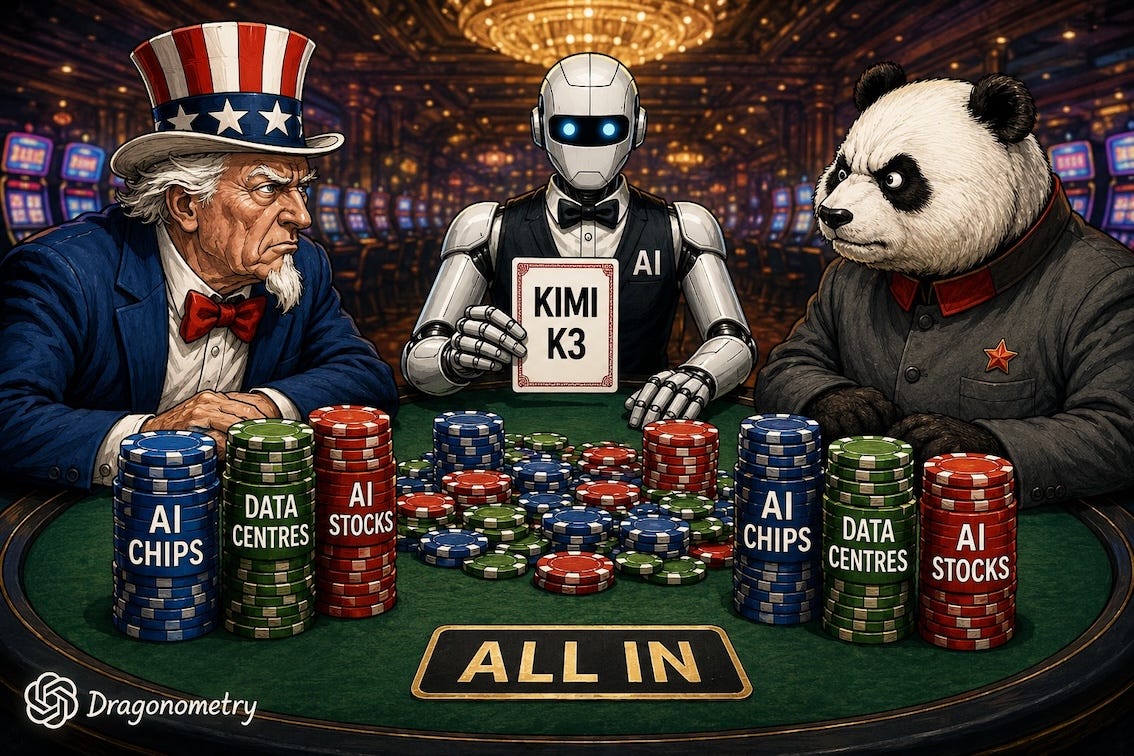
China’s version of the same bet
We have spent recent weeks somewhat obsessed with discovering an almost equivalent dependency on the AI trade inside China’s public finances, without even realising it until two days ago when China dropped its numbers for the fiscal ledger in June. Please bear with us, dear reader, as we walk you through what can appear sometimes to be rather dry detail. It is worth it once we share our epiphany.
China’s fiscal story this year is dominated by an older problem than AI euphoria: the collapse of land finance. For two decades, Chinese local governments financed a huge share of the infrastructure spending that has driven headline GDP growth by selling land-use rights to developers. That is not a tax on ongoing economic activity; it is, in effect, a one-off sale of an asset, dependent entirely on developers continuing to want more land. That well has been running dry for years, and 2026 has been especially unkind to it: land-use-rights revenue fell 31.5% in the first half of the year. This, in turn, has dragged the broader Government Funds Budget down by 16.4%. What this means, essentially, is that all the economic activity generated by the government’s expenditure on roads, bridges, trains, etc, has been shriveling because the funds necessary to drive it have not been there. The Government Funds Budget is walled off from all the other government spending that is needed to keep essential services going; if there is no income for building more roads, then more roads will not be built.
The remarkable thing is what did not fall alongside it. China’s General Public Budget — the ordinary budget funding health, education and social security — grew 1.5% in the first half, with health spending up 10.8% and social security up 7.6%. This budget is funded by broad-based taxes on transactions, profits and wages, not one-off land sales. Beijing has been able to protect the spending categories it calls essential because the revenue funding them tracks the ongoing churn of the economy rather than a shrinking asset sale. That is the good news, and it has let officials talk about “deliberate deleveraging” rather than crisis. Dinny McMahon, head of markets research at Trivium China, has argued this is close to what a genuine, controlled deleveraging campaign should look like: not blanket austerity, but a deliberate choice to let the old, land-dependent spending line contract while protecting the essentials and redirecting what remains toward strategic priorities.
But look at what is doing the work of keeping that ordinary budget’s revenue growing, and the American parallel appears. China’s securities transaction stamp tax — the closest thing the country has to a market-activity-linked tax — rose 110% year-on-year in the first two months of 2026 alone, following a 57.8% jump for the whole of 2025. That is not background noise in a multi-trillion-yuan budget. It is the direct fiscal signature of the same AI-and-chip stock enthusiasm that has sent China’s semiconductor champions racing toward record valuations, that has kept memory-chip exporters in Taiwan and Korea posting record numbers month after month, and that culminated, this month, in the enormous state intervention by the so-called National Team to stop a technology-led selloff from spreading through the broader market. The trigger for that selloff? Kimi K3’s release.
In other words, the same underlying phenomenon of the global, largely American-led enthusiasm for AI’s economic promise is affecting China’s numbers almost exactly as it is America’s. But doubly so. It supports Chinese exports of the memory chips and hardware feeding the global AI build-out. It supports Chinese tech-stock valuations, which supports trading volume, which supports the tax revenue letting Beijing hold its “protect the essentials” line. And, perhaps most importantly from the Party’s perspective, it supports the broader “new growth drivers” narrative: the high-tech manufacturing and modern services, now credited with over 40% of China’s first-half growth, which is supposed to be the replacement for the property engine that land finance used to fund.
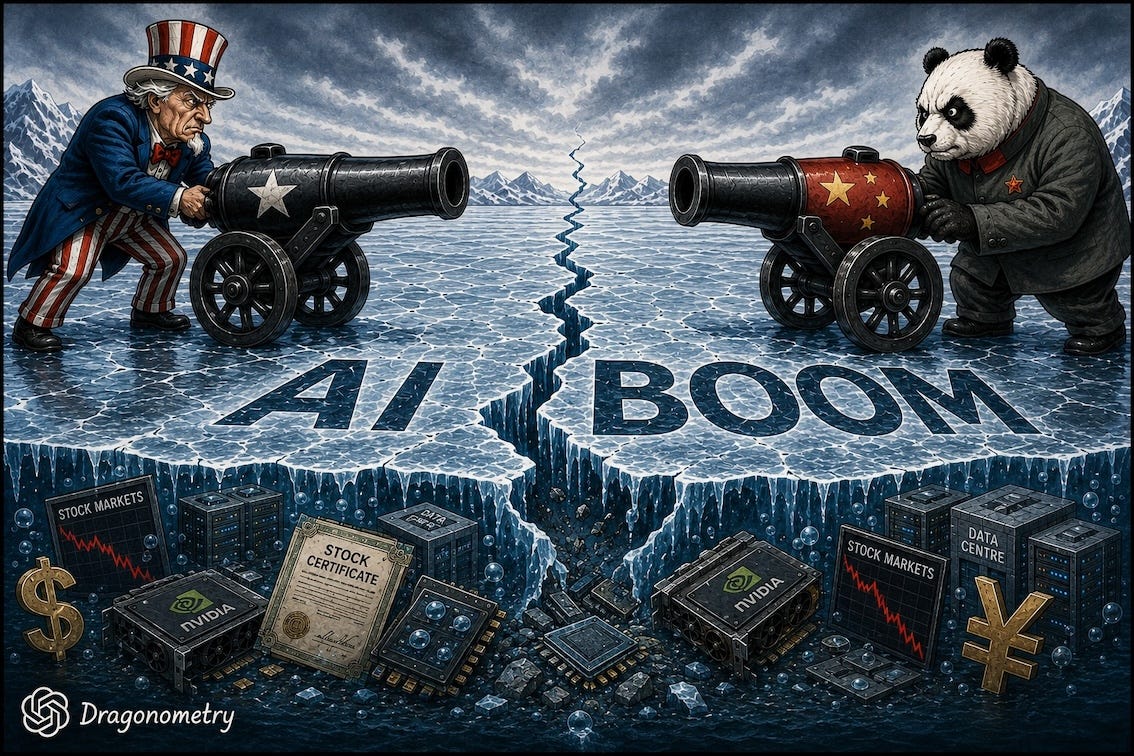
The week the bet got tested
Which brings us back to last Friday. What Kimi K3 threatened was not Anthropic’s or OpenAI’s technology in any narrow sense. Moonshot’s own account concedes the model still trails the leading closed systems on overall capability. What it threatened was the assumption, embedded in Kedrosky’s and Bridgewater’s and Deutsche Bank’s estimates, that the enormous capital pouring into frontier AI will eventually be rewarded with pricing power durable enough to justify it. Kimi K3 was reportedly priced at around a third of the cost of comparable models while completing close to three times as much work per dollar. If a Chinese lab operating under chip restrictions can get close to the frontier for that much less money, the premium that justifies trillions of dollars in hyperscaler capex looks considerably less secure than it did the week before.
Both governments’ responses over the following days are best read as reflexes to defend a narrative each has staked enormous capital on, rather than as coordinated theatre. There is no evidence the two coordinated anything, and treating this as collusion would overclaim what the facts support. But the family resemblance in how each responded is striking. Beijing’s response was direct and financial: state vehicles China Reform Holdings and China Chengtong Holdings disclosed roughly 9 billion dollars in equity purchases over the weekend, and CSRC Chairman Wu Qing personally pledged “all efforts” to stabilise the market on Monday, Reuters Breakingviews reports. State media coverage was equally telling in its framing, characterising the selloff as short-term liquidity strain and cross-border spillover rather than anything touching China’s underlying economic logic. That is the distinction that needed making if the “new growth engine” story was to survive the week intact.
Washington’s response was with bluster rather than cash, but served an almost equivalent function. Treasury Secretary Scott Bessent told Fox Business on Tuesday the administration would examine Chinese open-source models for intellectual property theft, warning sanctions were “on the table.” By Wednesday the language had hardened further, with Bessent stating “open source is not open season on American IP,” while White House science adviser Michael Kratsios claimed on social media that Moonshot had used improperly-accessed Nvidia chips and distilled Anthropic’s models to build Kimi K3. Reframing a competitor’s cost advantage as theft rather than achievement is not a neutral choice: it lets the American AI lead be described as under illegitimate attack rather than challenged, which is a materially easier story to tell investors than “the moat may be thinner than the capex assumes.” Yet it quickly became evident that the argument was on shaky ground. Nvidia’s chief executive, Jensen Huang, publicly countered the same day that distillation was “fundamental to intelligence” and that American companies should use Chinese models freely. Even the company that profits most directly from the chip side of this fight isn’t willing to back the theft framing.
This is not to say the IP-theft question is manufactured. Anthropic disclosed in February that it had traced roughly 3.4 million Claude exchanges to Moonshot, evidence, the company argued, of systematic extraction of its model’s capabilities. That disclosure named the same company behind Kimi K3, five months before the White House’s public accusation and well before any political pressure to make the case existed. Both things can be true simultaneously: a real, disputed technical and legal question, and a convenient vehicle for narrative defence. We would not want to collapse the two.
The BYD preview, played at a much larger scale
Zoom out from Kimi K3 for a moment, because the same underlying pattern governs Chinese competition in any traded good, a car or a token alike. Take the electric-vehicle story: a Chinese entrant undercuts an established, higher-cost incumbent not necessarily on absolute quality but on price and efficiency, at a speed the incumbent’s business model was not built to absorb. BYD did this to BMW and Mercedes; the labour, political and regulatory reckoning it has produced in Hungary and Brazil, which we covered this week, is the visible aftershock of exactly that kind of price shock landing inside a system unprepared to defend against it any other way than after the fact.
But the EV story, however severe for the specific companies and countries caught in it, is a fight over market share within an industry that is not responsible for holding up headline growth in the countries fighting it. Autos matter enormously to Germany. They are not, on the evidence above, the reason US or Chinese GDP looks the way it currently does. AI capex is. The Kimi K3 shock looks like the opening skirmish of a genuine price war in frontier AI. A model offered at a third of the going rate for comparable capability is difficult to read any other way. If so, the disanalogy with EVs cuts in China’s favour on one key dimension. A car is a physical object: it can be tariffed, inspected at a port, or forced into production at a foreign factory. An open-weight AI model is software. The moment its weights are published, it exists everywhere at once, and there is no customs post capable of stopping it. That is likely why Washington’s opening response to Kimi K3 was not a tariff — there is no coherent tariff against a file — but an argument about the legitimacy of the chips and training data behind it. If the fight cannot be fought at the border, it gets fought instead over who controls access to whatever comes next.
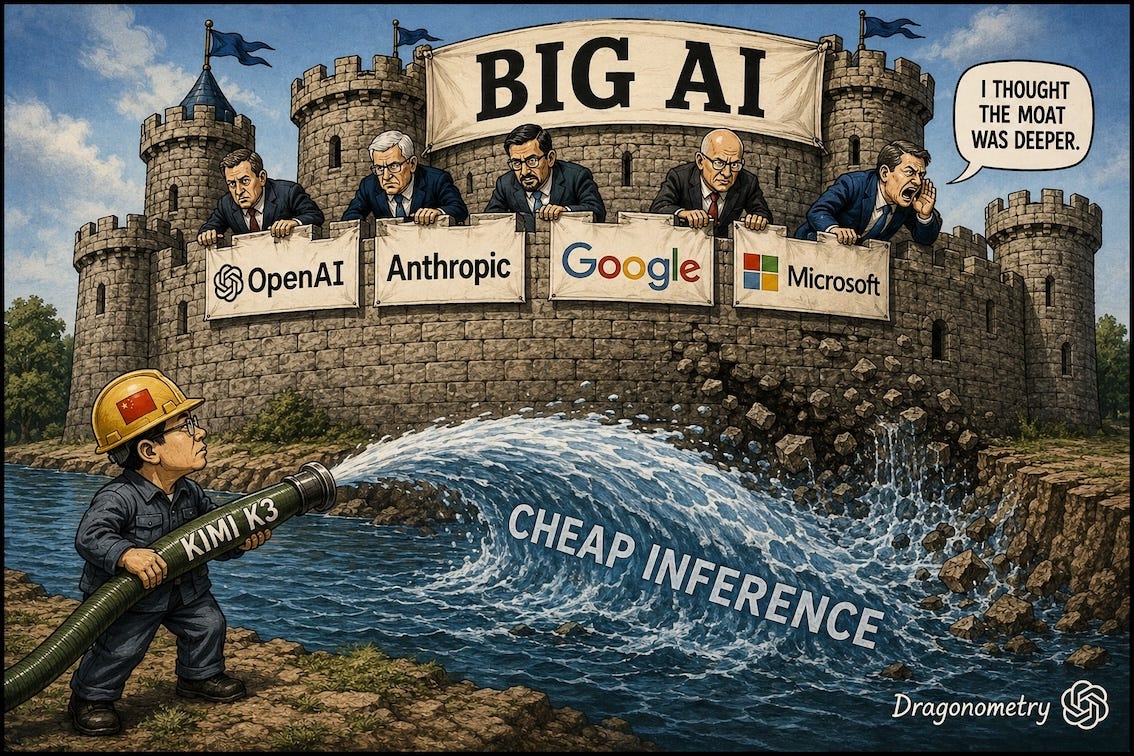
Compliance, not customs
If the fight cannot happen at the border, the boxing ring of where it does happen is visible. Axios reported that Washington has floated four separate restriction instruments over the past year: Entity-listing Chinese AI labs outright, an NSA public advisory against using their models, a White House executive order making cloud providers legally liable for hosting them, and Commerce Department supply-chain rules targeting Chinese open-weight releases specifically. All four were shelved by officials who prioritised innovation over restriction. The most senior of those officials, Sriram Krishnan, the White House’s senior policy adviser on AI and a co-author of the administration’s AI Action Plan, left his post at the end of June. National-security voices inside the administration have grown louder since, and Kimi K3 has given them fresh grounds to revisit the instruments previously set aside. This is a pattern tracked closely by Poe Zhao in his Hello China Tech newsletter: he had flagged it days before Axios confirmed it.
None of the four routes tries to stop a file crossing a border, because none of them can. An Entity List designation restricts who American companies can transact with, not what a downloaded model can do once it is running on a server in Ohio. A hosting-liability rule makes the cloud platform, not the model, the point of legal exposure. A supply-chain rule pushes the compliance burden onto whichever company built a product on the restricted model, whether or not it knew the model’s origin at the time. This is the shape the fight takes once the physical chokepoint disappears: not a checkpoint, but a standing legal risk that a company, a hosting provider or a downstream developer has to actively manage, the way sanctions screening or export-control due diligence works for other controlled goods today. It is slower, messier and harder to enforce evenly than a tariff schedule, and it hands lawyers and compliance departments a new job.
Worth noting too that not everyone pushing for restriction is doing so purely on security grounds. David Sacks, the former White House AI and crypto czar, has pointed to the two leading closed labs wanting the government to “eliminate their open-source competition.” That is an unusually direct admission, from inside the administration’s own orbit, that incumbent firms have a commercial stake in exactly the outcome the security case supports. That should sound familiar: it is the same alignment that shaped the EU’s tariffs on Chinese EVs, where genuine security and industrial-policy arguments coexisted comfortably with BMW’s and Mercedes’s straightforward interest in a competitor being kept out. Beijing’s mirror-image response, weighing whether to criminalise the leak or theft of Chinese AI model IP under its national security law and separately tightening rules on which foreign investors can fund domestic AI startups, suggests both capitals are reaching for the same kind of tool: not a border control, but a legal perimeter drawn around who is allowed to build on, invest in, or profit from the other side’s models.
Dragonometry’s view
We think this resolves the question we left open in “Kimi’s Moment.” Constructive Strategic Stability held this week. Marco Rubio and Wang Yi met calmly in Manila, September’s summit planning proceeded, and the dispute stayed in its lane. But it did not hold because the architecture was built to handle this kind of shock. It held because neither government could currently afford to let it not hold. Both have too much riding on the same AI narrative to want a fight over Kimi K3 to escalate into anything that threatens the broader relationship, when both need that broader relationship calm enough to keep investors and taxpayers believing in the underlying bet. That is not evidence CSS is robust. It is a more precise diagnosis of why it is fragile: the restraint we’re watching is not institutional, it’s situational, and it lasts as long as both sides keep calculating that a rupture would cost them more than the status quo does. The day either government concludes the other’s AI-dependent position is weaker than its own — or the day the shared bet sours for both at once, removing the mutual incentive for restraint — is the day we’d expect this particular peace to break first, and for a different reason than we originally thought. Two days after the week’s sharpest words, the same two governments sat alongside nineteen other APEC economies in Chengdu and co-signed a joint statement on AI cooperation. It was restraint chosen again, not a framework holding by itself.
Dragonometry is a reader-supported publication. Subscribe for the Daily Dragon and these Friday deep-dives.
Dragonometry draws on a wide range of open-source news and analysis. All external sources are linked directly. Claude.ai assisted in the production of this publication, but views and analysis (and errors) are the author’s own.