
China’s ‘new’ economic model: the good, the bad and the real (part 1)
Beijing is not going to rescue the property sector; its new economic driver is advanced manufacturing. Sounds good, right? It doesn't bear scrutiny, however: real estate is still being propped up.

This is the first of a three-part series that attempts to unpack how exactly China’s growth model is supposed to be changing, how it is actually changing (or not), and what the consequences of that change are likely to be. The essential argument across the three is this: China is widely said to be replacing an exhausted growth engine — land, construction, debt-financed local investment — with a new one built on advanced technology. We think the reality of what it is doing is both more troubling and more complex than that: the machine building the new model is the machine that built the old one, and it cannot stop doing what it is designed to do.
This first piece stays close to the ground, looking at examples of a wasteful model that the state cannot easily bring itself to quit. Part two, on Monday, pulls back from real estate to the whole economy and sees the same challenges. Part three, which follows next Friday, turns to where it all is heading and even takes a stab at how it might end (gulp). If you want to understand the single most consequential economic story in the world right now, this is our attempt to map it.
Too Broken to Restart, Too Charged to Switch Off
LATE LAST MONTH, at a site ninety minutes from Beijing, workers fitted a diamond-shaped crown to the top of the world’s tallest unfinished building. The 117 Tower in Tianjin — 596 metres of glass and steel, a “walking stick” capped by a crown built to hold a swimming pool — had stood as a hollow shell since 2015, when the developer behind it ran out of money and the country ran out of patience for towers like it. It became a destination for urban explorers, then a meme, then a shorthand for the moment China’s construction binge tipped into excess.
It is now nearly finished. As Caixin reported in a cover story on the restart, a consortium led by the state engineering group China State Construction, the state asset-manager China Cinda, and a Tianjin municipal vehicle took the project over for around 8.7 billion yuan ($1.3 billion); several thousand workers are back on site; completion is scheduled for 2027.
There is no tenant base for 117 floors of luxury office and hotel in Tianjin. There was none in 2015, which is part of why it stalled; the 530-metre tower already standing beside it has spent years short of occupants. The city does not need the building. The state is finishing it regardless.
The conventional way to read this is as a property story: one more marker in the long argument over whether Chinese real estate has found its ground zero. That is not wrong so much as focused on a smaller picture. The tower matters less as a building than as a piece of evidence about the state’s intentions. A government does not spend 8.7 billion yuan completing the most recognisable monument to property excess in the country because it makes sense for the market. It does so because the unfinished tower is the most conspicuous object on the skyline, and a finished one carries a message: the worst has passed, the situation is in hand. The restart is a confidence operation. And, like many confidence operations, it reveals how reluctant its operator is to let go of something. In this case, it is an economic growth engine, one that no longer works, but one that seemingly cannot be abandoned despite all the protestations to the contrary.
The number that landed the same week
On Tuesday 16th of June the National Bureau of Statistics released its May survey of new-home prices across seventy cities. Prices fell again, down 0.2% from April. On a year-on-year basis it was the thirty-fifth consecutive month of decline. The figure that matters most, though, was the one the headline tends to bury. Resale prices, which are subject to far less government intervention than new-build prices, fell 0.26%, their steepest monthly drop in three months.
That gap is small in magnitude and large in meaning. New-build prices are the ones the state can lean on. It does so through developer whitelists, purchase quotas, and the steady pressure on banks and local governments to support favoured projects. Resale prices are closer to a free market: millions of individual sellers, far harder to manage. When the managed segment falls slower than the unmanaged one, the unmanaged number is the truer reading of where the market is. The more realistic reading, this week, is that the market is still looking for a bottom, with the freer part of it sliding fastest. The 117 Goldin tower’s crown went on in the same fortnight the country’s resale market posted its worst month since winter.
The serious case that the bottom is in
It would be easy to wave this away as a bears-versus-bulls quibble, except that the bull case is held by people worth taking seriously, and made in terms that are not easily dismissed. In April, Guo Kai, executive president of the China Finance 40 Forum and a former economist at the People’s Bank of China’s monetary policy department, and his colleague Zhu He argued in a piece flagged by Pekingnology that China’s economy had passed a cyclical turning point and entered a mild but durable recovery. Their argument is notable precisely because it does not rest on stimulus. They read the downturn as a textbook supply-side clearing. It is a real-business-cycle adjustment, in property and in manufacturing, that has run long enough and deep enough to be largely complete. On this account the economy is recovering through its own endogenous repair, and needs no large policy push to do so.
On property specifically, Guo and Zhu are careful rather than triumphant. Their case is that 2026 is the year the market stops falling and settles into a bottom: prices may slip a little further, they allow, but the long contraction is close to spent. They point to private developers’ off-balance-sheet debt entering genuine restructuring, to Hong Kong-listed property shares stabilising, and above all to inventory: they see stock that rose every year from 2022 to 2024 but ran roughly flat in 2025, which they read as the clearing’s signature. Guo is explicit that the stabilisation will not be uniform. The weaker third- and fourth-tier cities, he says, may feel no stabilisation at all, while first-tier and strong second-tier markets settle first.
It is a coherent, well-evidenced case. The price-clearing is real, much of it has happened, and the people making the argument know the sector intimately. Dragonometry’s disagreement is not about whether China’s property market has been through a brutal adjustment. It is about who is doing the work of ending it: the market, clearing on its own, or the state, holding the floor in place.
The two readings make different predictions, and the May data is a small test between them. If the market were clearing spontaneously toward a true bottom, the freer segment — resale — would be where stabilisation showed first, because it is the part the state is not propping. Instead it is the part falling fastest. There is a signal buried in Guo and Zhu’s own argument, too. Pressed on whether 2026’s fiscal support is weaker than headline figures suggest, they concede that two of the larger line items — the 800 billion yuan a year in local-government debt-resolution bonds and the 500 billion yuan to recapitalise banks — are counted as fiscal expenditure but are not comparable to spending that lifts demand. They strip those sums out to show the “real” support is robust. The adjustment is reasonable. But it concedes the essential point: a large share of what is presented as support is the state absorbing old debt, not generating new demand. That is the thread this essay follows.
What the market shows when it is allowed to clear
If the question is whether Chinese property assets clear at a price, the auction market answers it more bluntly than the index does. Nicole Fu, a hotel-investment specialist who writes one of the more clear-eyed accounts of China’s distressed-asset market, has documented what distressed Chinese hotels now fetch at auction. An Evergrande property in Jiangsu sold for 56% of its appraised value — on a single bid. A Banyan Tree hotel in Chongqing went, after ten failed auctions, for 11.7% of its 2024 opening price. A Shanghai hotel marked down across four listings to 62% of its original asking price drew no bid at all.
Fu’s diagnosis is structural, and it is the same diagnosis the tower invites. These hotels were never underwritten as businesses. They were “face”. Amenities thrown up to lift a district’s prestige and help sell the apartment blocks around them, their operational flaws were masked by the property boom and exposed the moment it ended. At the time, the market prized spectacle: the grand lobby, the luxury flag, the vast ballroom. Whether the thing could ever function as a hotel was a question deferred, and is now being answered in the negative. A low price, Fu writes, is only the ticket to sit at the table; whether the asset can be turned into a working business is the real test, and for most of these it cannot. Buyers can see the discount perfectly well. They decline because cheap and viable are not the same thing.
The hotels are commercial assets, and the state has little reason to defend their prices. Residential property is a different matter, and it is worth being precise about how. Foreclosed homes do go to auction in China, and increasingly fail there: a Reuters review in January found rural banks unable to sell hundreds of seized properties even at discounts of 20% to 30%, with one 160-square-metre apartment in Dalian failing a second auction at 1.35 million yuan against a 2 million yuan market price. UBS expects the volume of foreclosed homes to climb from 640,000 units in 2025 to 2.43 million by 2027. But residential auctions tend to fail for a different reason than the hotels: not because an apartment is an unviable business, but because the distressed channel carries property-rights risks a buyer cannot easily price — sitting tenants, contested title, unpaid fees. And the state’s response to residential distress is the opposite of its indifference to a failed hotel. Cheap foreclosure sales drag down the prices of the occupied homes around them, which is to say they threaten the index the whole edifice rests on, and the savings of ordinary owners with it. So the channel is managed, restricted, and slowed rather than left to clear.
Set these cases beside the 117 Goldin tower and the shape of the problem appears more clearly. There are, in effect, three tiers. An asset the state chooses to rescue is propped, finished, its losses absorbed and the headline price held up. A commercial asset the state does not care to defend is left to the auctioneer, marked down to a fraction of value and often drawing no bid at all, because everyone can see it was never a real business. And residential property, where a true clearing would hit the price index and the household balance sheet at once, is neither rescued outright nor allowed to fall freely, but held in a managed limbo. The market clears the second kind ruthlessly, is not permitted to clear the first, and is slowed to a crawl on the third. That is not a market finding its bottom. It is a state deciding, asset by asset, which losses may be realised and which may not — reaching, when it is anxious, for the most visible reassurance it can buy.
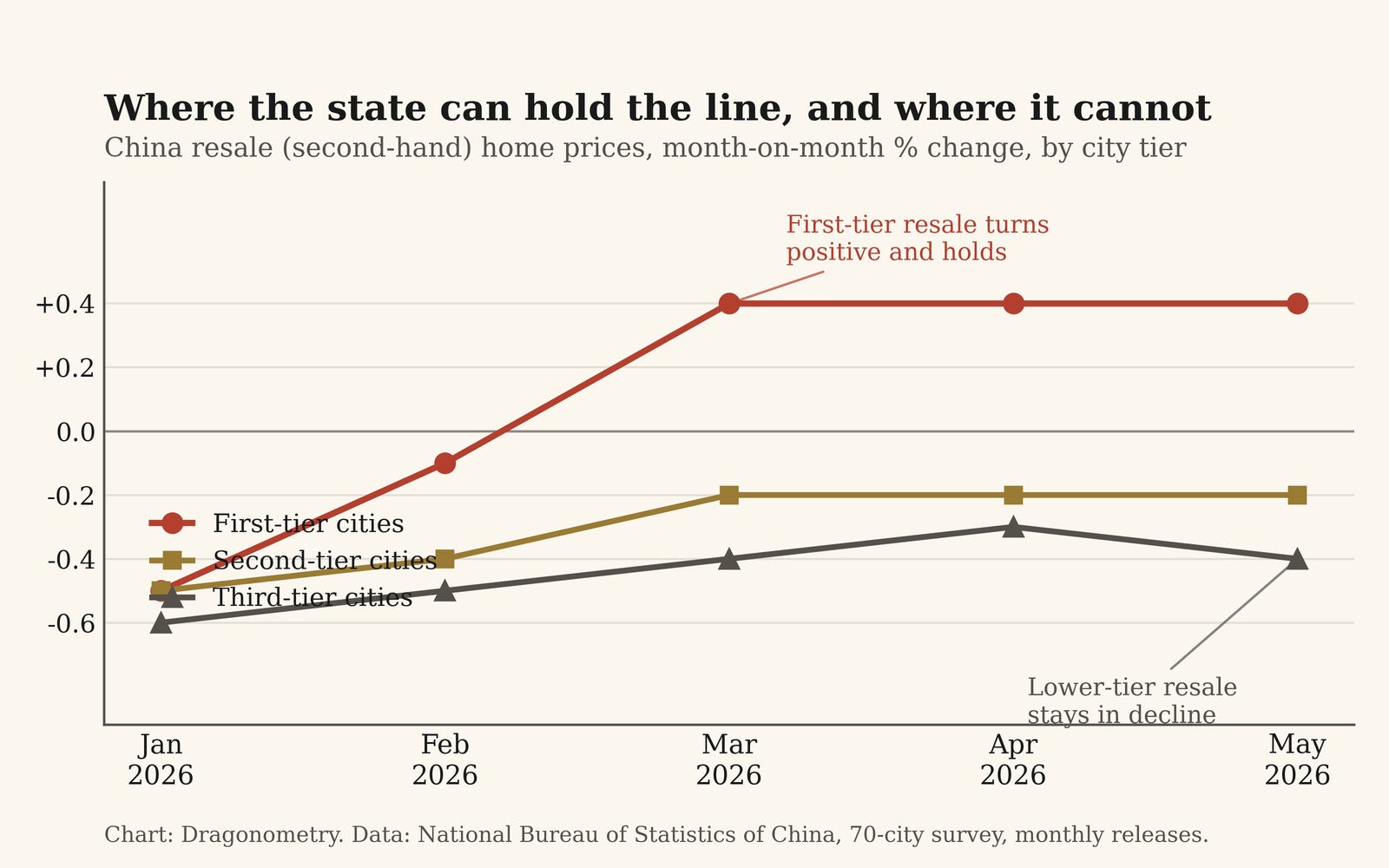
The official data shows the managing at work. Through the first five months of the year, resale prices in the four first-tier cities — where the state concentrates its support — turned from falling to rising, while the second- and third-tier markets it cannot reach as easily kept sinking.
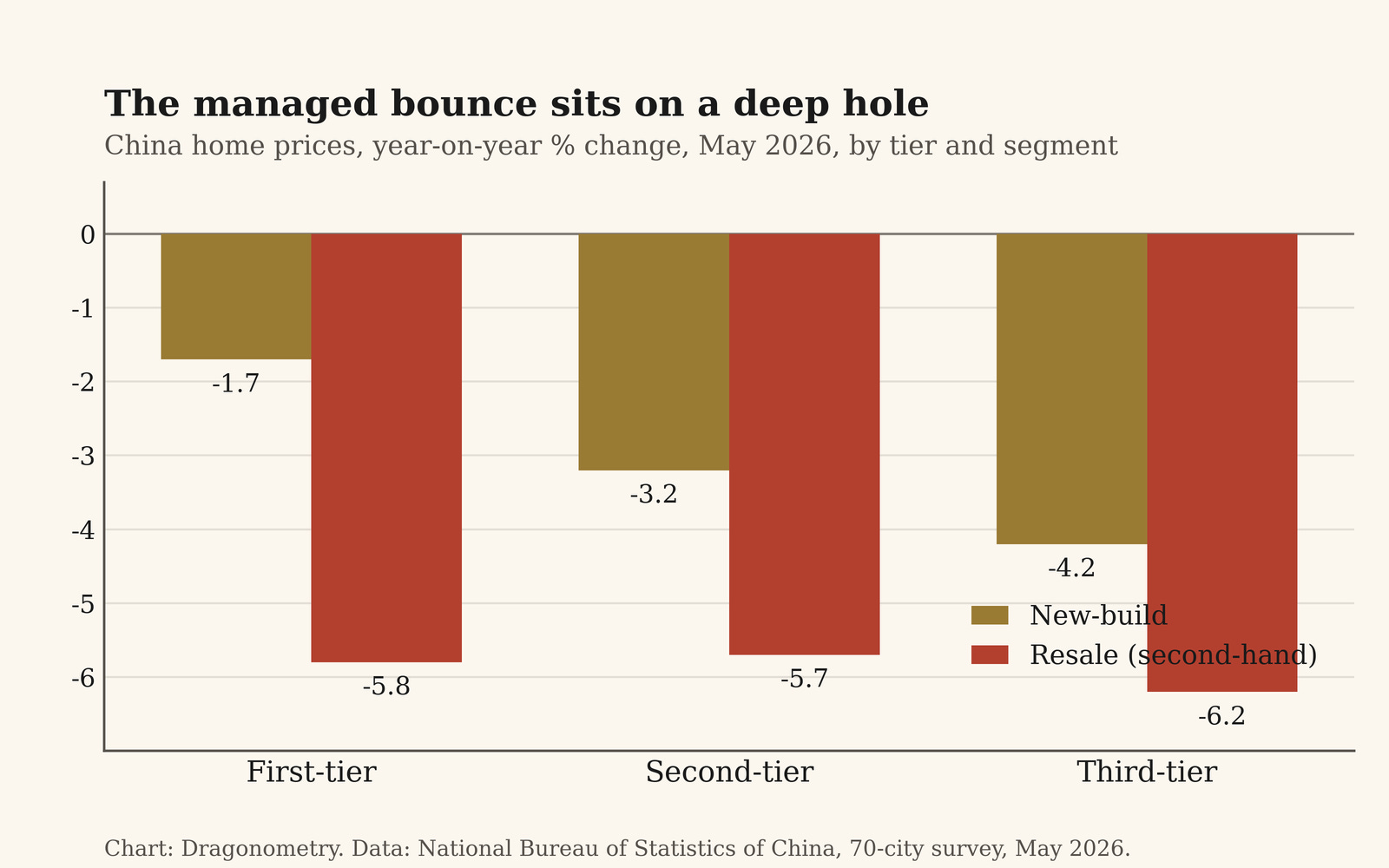
The monthly turn is real, but it is thin, and it sits on top of a deep decline. Measured against a year earlier, even first-tier resale prices are down nearly 6%, and resale trails new-build in every tier — a reminder that the recent uptick is a managed stabilisation laid over a market that has fallen a long way and not yet found its floor.
The refusal to choose
Why does a government finish a tower no one will fill rather than let the loss resolve? In China’s case, the answer is not all that mysterious: because it is part of a much bigger edifice being held up. To understand what that is, we turn now to someone who is not even writing about towers at all.
Ning Leng, a political scientist at Georgetown and the author of Politicizing Business: How Firms Are Made to Serve the Party-State in China, argues that China’s serial over-building is a feature of the political system rather than a malfunction of it. Officials are assessed from above, by their Party superiors, rather than from below, by the public who use what they build. That single arrangement bends the incentive structure toward the visible. The showcase wastewater plant gets built; the underground pipes that would make it work do not, because pipes impress no one. Applied to the 117 Tower, the logic is exact. The tower was raised in the first place to be seen, a developer’s monument, the tallest in the city. It stalled when the money ran out. And it is being un-stalled now not because the floors will fill but because a standing monument to failure is intolerable to a system that runs on visible signals of success. The first time, a private developer was signalling to the market. This time the state is signalling, to its citizens and to itself, that the property crisis is contained. The cure for a failed visibility project is another visibility project.
What the rescue costs
The signal is not free; the cost is what the confidence operation is designed to obscure. The debt that stalled the tower did not evaporate when the state stepped in; it was absorbed. The original developer, Pan Sutong, was declared bankrupt in 2022 with liabilities above 100 billion yuan, much of it non-performing loans from Bank of China and Citic, several of whose executives have since been investigated or sentenced. Those losses were not allowed to clear. They were moved onto public balance sheets — a state engineering firm, a state asset-manager, a municipal vehicle — and fresh money is now being spent to convert a dead asset into a finished one. It is the characteristic move of the whole system: the state absorbing the cost of a model it will not permit to correct.
The trouble is that the institutions doing the absorbing are themselves wearing thin. Bank of China, which carried much of Pan Sutong’s bad debt, is one of a great many under the same strain. Nikkei reported this month that close to nine in ten listed Chinese banks have fallen below the profitability threshold an industry body deems necessary for stable operation, their margins squeezed as the property slump grinds on. Weak earnings, the report notes, threaten the bad-loan cleanup itself. The banks are the balance sheet onto which the property bust’s losses have quietly been moved. A banking system that cannot generate enough profit is a system with less room to absorb the next tranche of soured property and local-government debt, at exactly the moment more of it is arriving. The capacity to keep rescuing is eroding even as the need for rescue grows.
The serious reform, and the pathology inside it
None of this is to say Beijing is doing nothing but prop up towers and watch auctions fail. The more serious response is a fiscal reform now under way across several provinces, and the clearest account of it comes from Dinny McMahon, Trivium China’s head of markets research, in conversation on the Trivium China Podcast in early June. It is worth setting out as he does, because Dinny is broadly persuaded by it despite having a fearsome reputation as a BS-detector, and the argument here borrows his evidence before diverging from his conclusion.
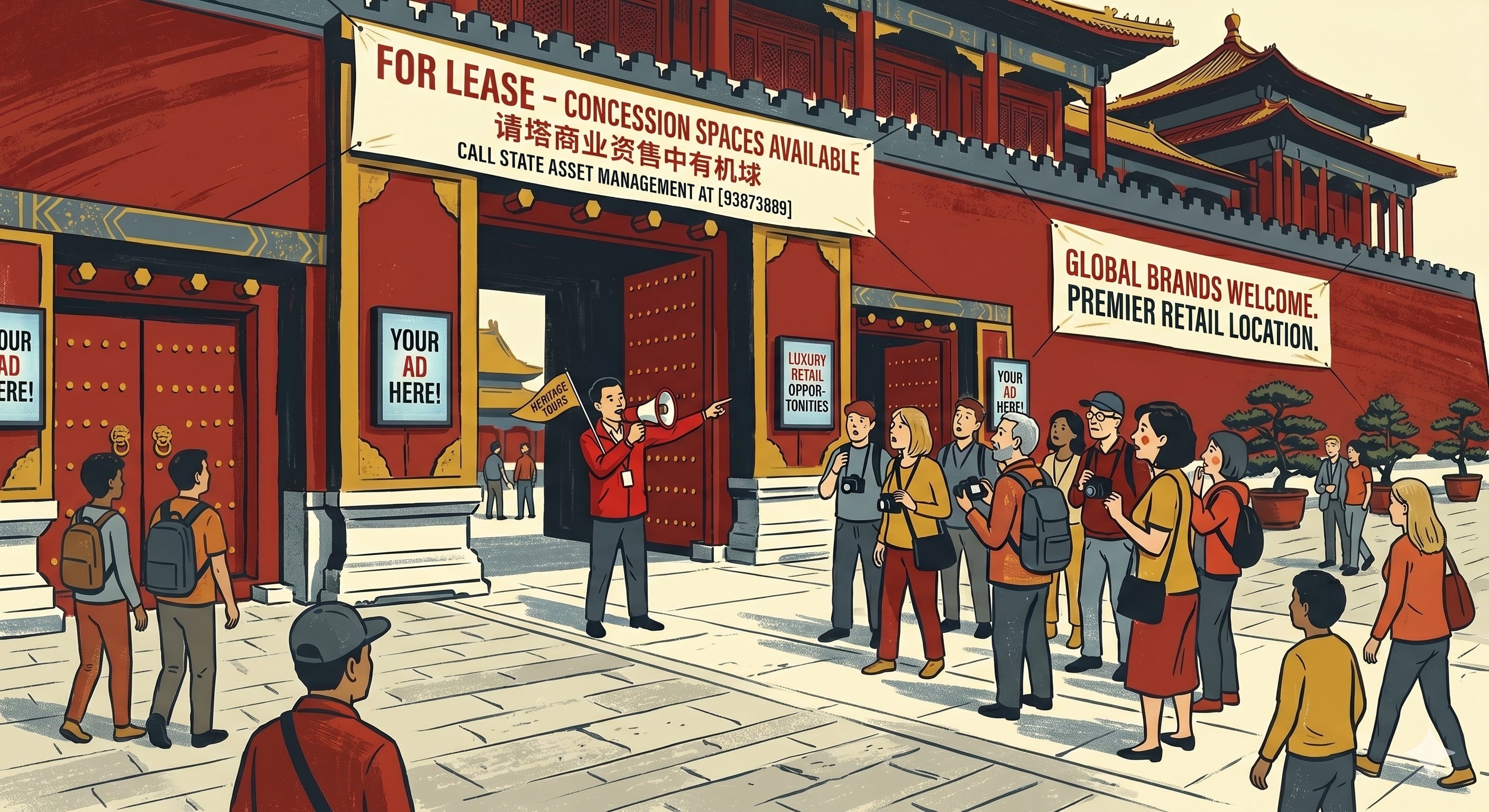
The reform is called asset revitalisation, or, in the Chinese financial press, state-asset monetisation. With land sales collapsed since 2021 and Beijing adamant it will not bail local governments out, provinces have begun turning idle state assets into recurring revenue: selling long-dated concessions on everything from mining and fishing rights to billboard space, train-station retail and the management of public facilities. McMahon’s case, built on a Trivium study of the numbers, is that this is real and already material. In Chongqing, charges on the usage of state resources rose from 6.4% of the city’s budget in 2021 to 15.1% in 2025; in Shandong, from 5.3% to 12.9%; in Jilin, from 2.4% to 9.2%, enough that the province was lifted off the central government’s heavily-indebted list. He is, on the evidence, a qualified optimist: the strategy is spreading, Beijing is behind it, and it will help.
The scramble is itself a measure of how acute the distress beneath has become. The most arresting number comes from inside the establishment rather than from its critics abroad. David Daokui Li, a Tsinghua professor, head of its Center for China in the World Economy, and a former member of the People’s Bank of China monetary policy committee, put unpaid arrears to contractors and civil servants at some ten trillion yuan as of the end of 2024. That is what austerity looks like in a system that will not announce it: not visible cuts to services but bills left unpaid, the shortfall pushed quietly down the chain to whoever is owed. A reform that turns billboards and fishing rights into cash is the response of governments with little else left to sell.
McMahon’s own caveats are where the wiring shows through. He names three risks, and each is the old pathology in new dress. The first is self-dealing: a local government sells a concession to a state firm it owns, the firm borrows to pay, the asset underperforms, and the result is hidden debt, precisely the land-to-LGFV manoeuvre that followed the property bust, run again. The second is the sugar high: deals structured as one-off upfront payments plug this year’s hole while leaving no durable stream, so revenue may flatline or fall. The third is management: a state firm with no relevant expertise wins the concession and cannot make the asset pay. His sharpest example is a Shandong county that sold thirty-year rights to a “low-altitude economy” zone for nearly a billion yuan to a state firm incorporated, by his account, the day of or the day before the auction, funded by leverage no one can fully trace. Even Shandong’s own 2025 budget concedes the ceiling, warning that the room for revitalising existing assets is narrowing and constraining revenue growth.
Where this argument parts slightly from McMahon is in reading those three risks not as likely teething troubles a maturing programme will grow out of, but as the same incentive that built the empty towers reasserting itself inside the supposed cure. Each risk is a familiar temptation: the state transacting with itself, leverage pushed off the visible books, a one-off signal of success preferred to the slow work of building durable value, capability assumed where none exists. The reform is genuine, and that is what makes it instructive. This is not to say that productive exceptions to the rule cannot materialise. It is to say that, handed a mechanism to monetise idle assets honestly, the system bends it back toward self-dealing and hidden debt, because those are the incentives it runs on. The repair reproduces the thing it was meant to repair.
What it refuses
Set the 117 Tower beside the auctions and the revitalisation reforms, and the contradiction at the centre of the model comes fully into view. Assets that could clear are not allowed to: the state intervenes, absorbs the loss, finishes the building, holds the price up. Assets the state does not rescue cannot find a buyer at a fraction of value, because their lack of underlying viability is plain to everyone. And the reform meant to raise honest revenue from what the state already owns keeps sliding back toward the leverage and self-dealing it was supposed to replace. The old engine is at once too broken to restart on its own and too politically charged to switch off; the mechanism built to succeed it inherits its reflexes.
So Beijing chooses neither course cleanly. It will not let the market finish clearing, which would mean realised losses, failed banks, and falling prices it has spent years holding up. It will not commit to the deep reform that might actually replace land revenue, which would mean ceding the control the whole system is organised around. It holds the contradiction in place instead, rescuing what it must and monetising what it can, and calls the result stabilisation.
This is the same posture readers of this publication will recognise from the way Beijing manages its currency, where we argued last week that the force required to hold the yuan at two values is the truest reading of the pressure behind the Great Currency Wall. The property machine is the domestic leg of the same play: a state managing a set of contradictions by quiet force, the cost kept off the visible books.
The gauge to watch, then, is not the headline price index or the GDP print; those are the managed variables. It is the frequency of the rescue: how often, and at what scale, the state must step in to finish a tower no one will fill, absorb a loss no buyer will take, hold up a price the market would let fall. Each rescued white elephant is a measure of how much of the old model still has to be carried, and of how far the new one remains from carrying itself.
That leaves the larger question this essay has set aside: if the rescues only grow more frequent, what is it all building toward, and what does the bill finally amount to? That is a matter of the whole economic growth model rather than the property sector alone, and the subject of the second piece in this series:
—> Part 2: Same Machine, Newer Waste
Dragonometry draws on a wide range of open-source news and analysis. All external sources are linked directly. Claude.ai assisted in the production of this publication, but views and analysis (and errors) are the author’s own.