
The man and his party
Part 1 of our series on the politics of China’s economics: Everyone has a theory of what is wrong with the thinking of Xi Jinping. It would be better to focus on his constraints.

All Dragonometry content is free for now — the paywall goes live on 1 August (see offer at end).
This series follows on from our three-part series that examined the challenges facing the Chinese economy. That trilogy ended at a border it could not cross: it showed that China’s growth model is exhausted, that the solution is known — raise household incomes, build the safety net, let consumption carry the economy — and that the solution is nonetheless declined. Why it is declined is not an economic question. It is a political one, and that is the subject of this series. We begin with the figure everyone reaches for first: the man at the top.
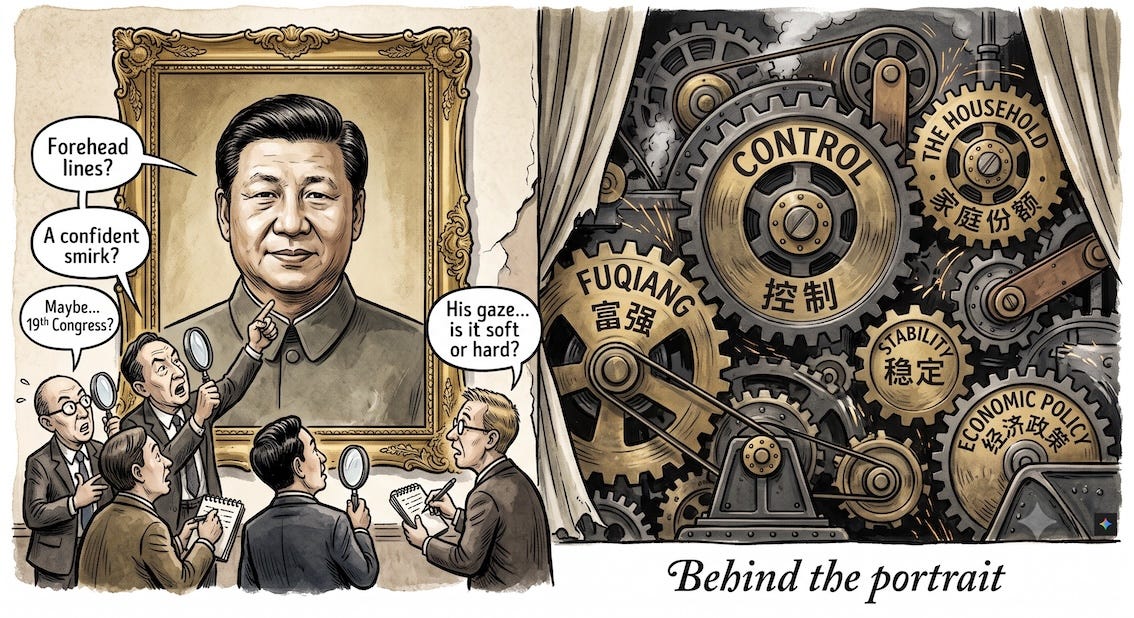
THERE IS A QUESTION that has organised more than a decade of writing about China, and it is usually put with some exasperation. How did it come to this? The once-autarkic country that opened its economy, lifted hundreds of millions out of poverty and seemed, to a generation of optimists, to be edging toward something looser and more plural: how did it end up here, with power gathered into one pair of hands, the private sector cowed, the reform era spoken of in the past tense? The answer most observers give is a name. It came to this because of Xi Jinping.
The case is easy to state. Here is the most powerful Chinese leader since Mao Zedong, a man who abolished the term limits that were meant to routinise succession, who has bent the Party, the state and the army around himself, and who has spent his years in office tightening rather than loosening. If the reform era is over, he ended it. If the economy is captive to control, his is the instinct for control. Explain the man, on this reading, and you have explained the country.
Tempting as that is, it is the wrong place to start in understanding China. This series is going to argue that focusing on agents and actors rather than the system of governance is a category error, one that mistakes a phase of a very long historical cycle for the work of individual will. We will spend six essays on it. This one starts where the error starts: with the man himself. The claim here is narrow and, we think, decisive. The obsession with what is wrong with Xi reveals less about Xi than about a habit of mind that wants history to have an author. He may be the most powerful leader in several generations. He is also bound by the weight of Chinese history and Party culture as much as any leader before him, and the model everyone calls his is not his at all.
What the father tells us about the son
Many works have been written to explain Xi Jinping since he came to power. The most illuminating of these to appear in years is not about China’s current leader. It is about his father.
Joseph Torigian, an associate professor at American University’s School of International Service and a research fellow at Stanford’s Hoover History Lab, has written the first English-language biography of Xi Zhongxun, the revolutionary elder who served the Party for more than seven decades. The Party’s Interests Come First runs to seven hundred pages and is, on its surface, a life of the father. Its deeper subject is the machine that made both men.
The conventional story about Xi Zhongxun is that he was a relative liberal: a backer of the experiments in Guangdong province that spawned the miraculous city of Shenzhen, an ally of the tragic reformist figure Hu Yaobang, a man purged by his own Party and therefore, surely, no devotee of its harsher instincts. From that portrait grew an expectation that hardened into a forecast: that the son of such a man, himself sent down and humiliated in the Cultural Revolution, would carry a reformer’s sympathies into power. When Xi Jinping did the opposite, the conundrum wrote itself. As one reviewer of Torigian’s book put it, observers were left asking what went wrong.
Torigian’s answer is that the premise was wrong. The liberal Xi Zhongxun is, he argues, partly a retrospective myth: a portrait assembled from selective episodes. The father’s deeper loyalty was not to any reform programme but to the Party itself. This survived through the kind of persecution that would have broken a weaker attachment. He could be flexible, even ruthless; what he would not do was betray the institution, even one that had treated him so badly. That is the inheritance that matters. Torigian frames it with a question sharper than the usual one: not why Xi Jinping might have abandoned his father’s liberalism, but how he could possibly betray the Party for which his father sacrificed so much.
This is what sets Torigian’s analysis apart. Most biographies treat Xi as a free agent whose choices express his personality. Torigian shows a man shaped, as he told NPR, by multiple sources of gravity: Party culture, inherited suffering, a political world in which loyalty was proved by enduring the institution’s cruelty without turning against it. The son did not break with the father. He absorbed the father’s lesson, which was the Party’s lesson: that the organisation’s interests come first, and that this is not a slogan but a way of being. Torigian is careful that his book illuminates the son only indirectly, through the father; the restraint is part of why it persuades. He is not psychoanalysing a sitting leader. He is reconstructing the culture that produced him.
Read this way, the interesting thing about Xi is not how unusual he is but how representative. He is a product of a particular formation, holding a line that the formation taught him to hold. The question “what is wrong with Xi” assumes a man who could have chosen otherwise and didn’t. Torigian’s Xi is something else: a figure acting in close accordance with the gravity that made him.
How he came to power, and what was missed
None of this is to say the man has no agency. The way Xi took power was a feat of political skill, and the grievance now directed at him is partly the recoil of people who admired that skill and then felt deceived by where it led.
Recall the moment. In the months before the 2012 leadership transition, the Party was visibly fracturing. Bo Xilai, the charismatic Party secretary of Chongqing, was mounting an open, populist, neo-Maoist challenge from the left, complete with red-song revivals and a personality cult. It was the most serious factional threat the post-Deng order had faced. Desmond Shum’s memoir Red Roulette, an insider account from the heart of the Party’s business elite, describes from close range how Xi turned the Politburo Standing Committee against Bo and dispatched him. Vanquishing a rival attacking from the radical left did not make Xi look like a hardliner. It made him look like the stabiliser: the man who put the fractures back together and steadied a regime that had started to come apart.
That is why the early read on him was cautiously optimistic, and not foolishly so. At his first Party plenum, the Third Plenum of November 2013, the leadership pledged to give the market a “decisive role in the allocation of resources“ and issued a long reform document that seemed to promise a more market-driven economy. Serious analysts called it a turning point. Here, it appeared, was a centrist and a pragmatist, a competent manager who had beaten the populist and would now get on with reform.
What that read missed had already been said, a year earlier and in plain sight. On 29 November 2012, days after taking over the Party, Xi visited the National Museum and gave the speech that introduced the Chinese Dream: the great rejuvenation of the Chinese nation. It was a manifesto aimed at stanching the country’s wound of the “century of humiliation,” with national strength as the organising purpose. It was not an economic-reform speech. It was a mission statement, and everything that followed grew from it. The market language of 2013 was a means; the rejuvenation destiny set out in 2012 was the end. Those who took the means for the mission, and were later shocked by the centralising turn, had simply read the wrong speech.
The model he inherited
If the man is less of a free agent than certain political theories need him to be, the natural objection is that the policies are still his. He may be a product of Party culture, but surely the statist turn in the economy was authored by him. The state reasserting itself over the market, households squeezed so that producers and the state can be fed: surely that is the Xi programme.
It is not, and the person who has documented this most rigorously is worth reading in depth.
Yasheng Huang, the Epoch Foundation Professor of Global Economics and Management at MIT’s Sloan School of Management, staked out a contrarian position two decades ago by arguing that China’s real miracle was the entrepreneurial, rural, market-driven growth of the 1980s, and not the state-led urban model that followed from the 1990s onward. His new book, Statism with Chinese Characteristics, published by Cambridge in a substantially reworked second edition, turns that argument into a verdict. The title change says it all. The earlier book was called Capitalism with Chinese Characteristics; the flip from capitalism to statism is Huang telling us which side won.
The history he reconstructs runs against the grain of the standard timeline. The 1980s, on his account, were the genuinely liberal and inclusive decade: light financial reform, private rural enterprise, the most politically open stretch of the People’s Republic, and — not coincidentally — its healthiest growth. What came after was a reversal. After 1989, the leadership that consolidated under the so-called “Shanghai faction” of Jiang Zemin and Zhu Rongji rebuilt the economy on a statist, urban, infrastructure-heavy footing. Households were systematically subordinated to the imperative of boosting production. The chapter titles carry the thesis without apology: “The State Strikes Back,” then “Statism with Chinese Characteristics.”
The crucial point for our purposes concerns timing. In Huang’s earlier edition, the question of whether China might swing back toward the 1980s model was still open: the Hu Jintao and Wen Jiabao years looked, for a moment, as though the state might reach again for rural reform and create a fairer deal for households. The new edition closes the question. They tried, and they failed, and the statism kept going. By the time Xi arrived, the model was a settled inheritance, built by others, already two decades entrenched. He is the continuation of what Jiang was set to do, not its author. Because the book speaks to the present directly, it carries that verdict itself: this is what the model is, and it is not the current leader’s invention.
The inheritance can be seen in a single structural fact, the one our economics trilogy kept returning to. Across the reform era, the household share of the Chinese economy did not rise with the country’s wealth. It fell, and then it got stuck.
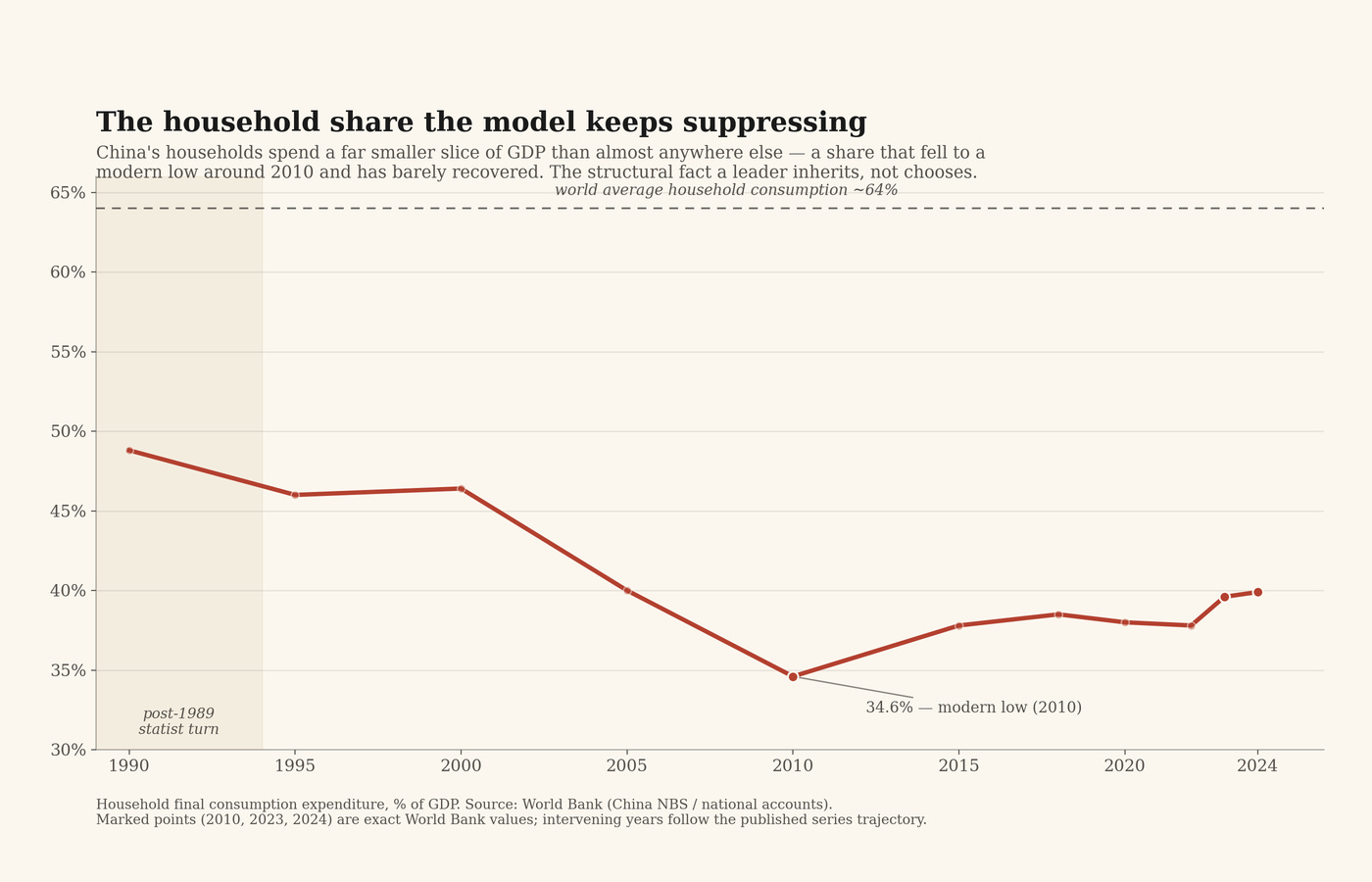
China’s household consumption as a share of GDP across the reform era: a slide from roughly half of output to a modern low of 34.6% in 2010, with only a weak recovery to about 40% since, against a world average near 64%. One consistent World Bank series; the 2010, 2023 and 2024 points are exact, the intervening years follow the published trajectory. Source: World Bank / China NBS.)
This is not a chart of a policy. It is a chart of a model: a long decline in the household share of the economy that begins under Jiang and Zhu, deepens to its modern low in 2010, on Hu and Wen’s watch, and is still well below the world average under Xi. The detail matters: the share kept falling hardest through the very years the reformers were meant to be tilting the economy back toward households. Whoever sat at the top, the household share kept being suppressed, because suppressing it is how the economic model generates the surplus it runs on: the Party cannot allocate resources decisively in a system unless it controls how household savings are spent. That is the sense in which the solution is declined by the system and not merely by the man. To lift that line back toward the world average would mean dismantling the transfer from households to the state that the whole structure depends on. No leader formed by this Party, inheriting this model, has been willing to do it. Our economics trilogy showed that the cost of not doing it is real and rising. Understanding the political foundations for this begins by noticing that the system’s refusal to do otherwise is older than the present leader.
The category error
Put the two books together and the great-man theory is structurally weakened. The leader is a product of Party culture, formed to put the institution first (Torigian). The model is an inheritance, built after Tiananmen by others and entrenched across two leaderships before Xi took office (Huang). What is left for the theory to explain?
Something, but less than it thinks. Xi has plainly intensified the Party’s centralising turn. The abolition of term limits is his, the cult of personality is his, the sheer concentration of authority is his. There are those who would also highlight the influence of Wang Huning, the Party’s current No. 4 ranking official, often described as China’s ideology czar, who has advised all three presidents since 1989. But we think that Wang, too, is a product of the system’s inherent ideological narrative rather than its creator. The moment at which China finds itself on its theoretical journey has a history much more ancient than its current ideological master or his political boss can claim credit for.
We are not arguing that Xi is incidental. We are arguing that he is a phase, not an origin. He might be the high-water mark of a strong tide. Yet to read him as the author of the current Chinese politico-economic model is to mistake the most visible swimmer for the current that swept him there.
This matters beyond getting one biography right, because the great-man frame tends to smuggle in a comforting forecast. If the problem is Xi, then the problem has a term limit of its own: wait him out, and the reformist China that was always trying to be born will resume. The history reconstructed by Torigian and Huang offers no such comfort. The instinct that Xi embodies — to gather power to the centre, to put the Party’s cohesion ahead of all else — did not begin with him and shows no sign of being the property of one man. Reformers who tried to loosen the grip, from the 1980s liberals of Hu Yaobang and Zhao Ziyang to Hu Jintao and Wen Jiabao, were defeated by something larger than any rival. Understanding what that is — why the Party, time and again, chooses self-preservation at all cost, and why the reformers reliably lose — is not a question about Xi at all.
It is a question about the system, and about a cycle older than the People’s Republic.
There is a line Chinese readers know by heart, the opening of one of the classic novels: the empire, long divided, must unite; long united, must divide. It is usually read as a law about territory, starring warlords and empires, to explain the historical cycles of the country’s fracture and reunification. The argument of this series turns on a quieter version of the same instinct: not the country splitting and reuniting, but power concentrating and dispersing within a state that stays whole. China today is not fragmenting. It is centralising, hard, and Xi is the peak of that swing: the latest turn of a pendulum that ran from Mao’s hyper-centralisation, to Deng Xiaoping letting the provinces experiment and some people get rich first, to the long re-gathering that has been under way since the 1990s.
Why the pendulum swings the way it does, why it has so reliably defeated those who tried to hold it at the decentralised end, and why the Party treats its own concentration as something close to a law of survival: that is where this series goes next.
Next in the series, Part 2: why the Party always chooses itself. If the model is not the man’s, it belongs to a system with a very long memory. We draw on the late Joseph Fewsmith of Boston University on why power at the top of a Leninist system can never be safely institutionalised; Orville Schell of the Asia Society, with John Delury, on the century-long drive for wealth and power; and Andrew Nathan of Columbia, with Andrew Scobell, on the chronic insecurity beneath it. And we revisit the affair that brought down Bo Xilai, told by the journalists Wenguang Huang and Pin Ho, as the moment the Party’s own fracturing showed through.
Dragonometry draws on a wide range of open-source news and analysis. All external sources are linked directly. Claude.ai assisted in the production of this publication, but views and analysis (and errors) are the author’s own.
Anthony. I think this is a very good analysis. Thank you! Having read 'The Party comes first' I entirely share your view. My only question is whether you are going to include the demographic issues in your analysis?
Our research on the impact of the One Child Policy and the effect on the Sex Ratios at Birth suggests it is now impossible to boost domestic consumption in any meaningful way. Simply put, our narrative suggests that the 90+ million girls who haven't been born since 1980 (using official SRB data), can't now have babies of their own. And so there is also no way of solving the property crisis, as the decision to marry and have babies is the critical driver for home purchase.
Xi is therefore trapped in terms of policy choices, even if he wanted to boost domestic consumption.
Our December Newsletter gives more detail, in case of interest https://new-normal.com/economic-growth/chinas-property-crisis-tops-beijings-priority-list-for-2026-but-may-prove-too-big-to-solve/