
Why the Party always chooses itself
Part 2 of our series on the politics of China's economics. Today: the weight of history that hangs on every Chinese leader and limits his individual choices.

This is the second essay in our series on the politics of China’s economics. You can read the overview, which lays out the structure of all six, and the three-part series that preceded this, which explains China’s economic growth model. This series will conclude by July 31, after which it will move behind a paywall. See subscription offer at the end, or click this appealing orange button below.
TO RECAP: Part 1 argued that the obsession with what is wrong with Xi Jinping is a category error: he is a product of Party culture, while the household-suppressing growth model everyone calls his was built by others, and entrenched, before he took power. That leaves a question. If not the man, then what? The answer this essay proposes is the system, and a series of choices stretching back further than the People’s Republic itself.
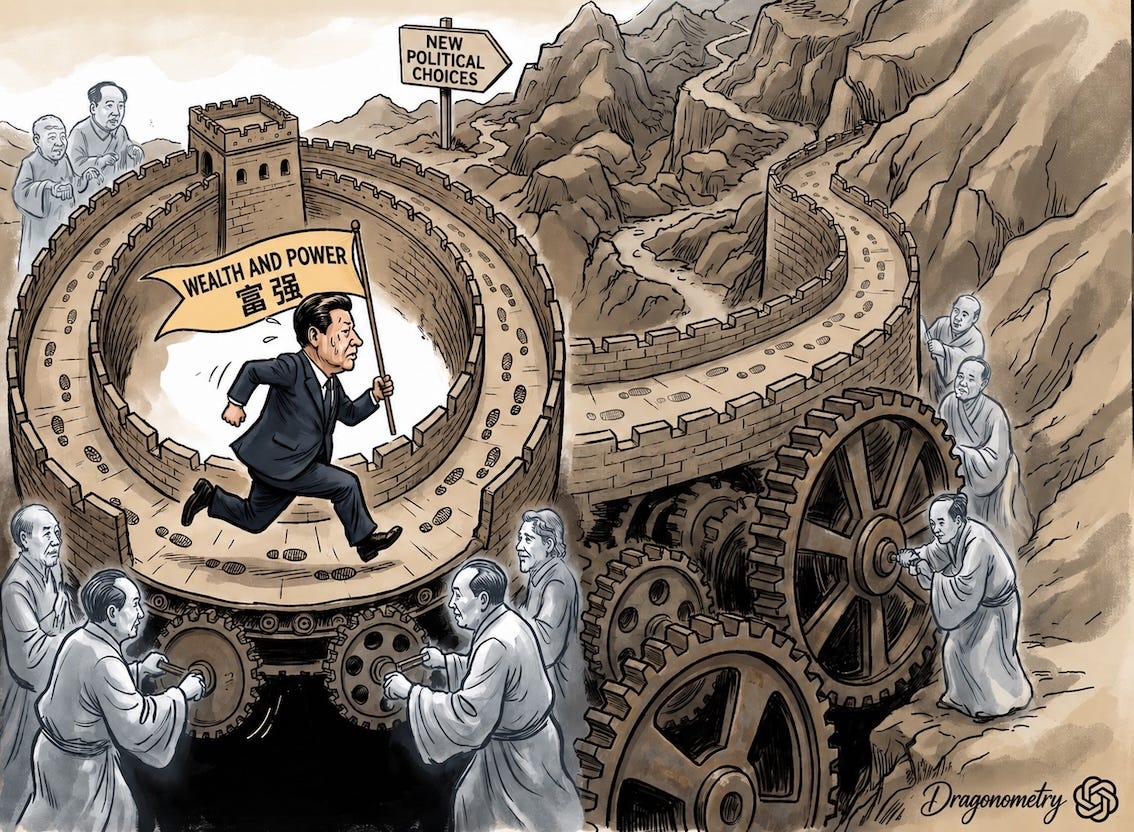
THERE IS A LINE that every Chinese schoolchild knows, the opening sentence of one of the four classic novels, Romance of the Three Kingdoms: the empire, long divided, must unite; long united, must divide. It is usually read as a law about territory. Warlords carve the country into fragments; a strongman reunifies it; the unified empire decays and fractures again; the cycle turns. Read that way it is a story about the map of China, about whether there is one state or many among the myriad linguistic and cultural groupings that today are counted as provinces, municipalities, autonomous regions and special administrative regions.
This series borrows the line to consider a similar and yet different challenge facing the Party leadership. The argument is not about the country splitting and reuniting, because China today is not fragmenting. It is about power concentrating and dispersing within a state that stays whole. The classical saying describes a centrifugal and centripetal rhythm in Chinese political life. That rhythm did not end when the territorial question was settled by the PRC’s founding in 1949. It moved inward, to the machinery of rule: not unity against division, but centralisation against decentralisation. China is one country, and it is centralising, hard. The pendulum that the old novelists watched swing between empire and warlords now swings between the centre gathering power and the centre letting it go.
Although “modern China”, a phrase beloved of the Party, started off on shaky ground, its first leader, Mao Zedong, pulled everything to the centre, to a degree no Chinese ruler had managed since, probably, Qinshi Huang himself. The country nearly broke under the strain. Deng Xiaoping let it loose: provinces were allowed to experiment, special zones were created to bend the rules, some people and some places to get rich first. The entrepreneurial decade of the 1980s, following Mao’s death in 1976 and Deng’s launch of reforms in 1979, was the dispersed phase of the cycle. Then, after the horrific events of Tiananmen in 1989, the centre began to pull power back, and it has been pulling ever since. As laid out in Part 1 of this series, Xi is not the author of that centralising turn. He is its high-water mark, the latest and highest swing of a very old pendulum.
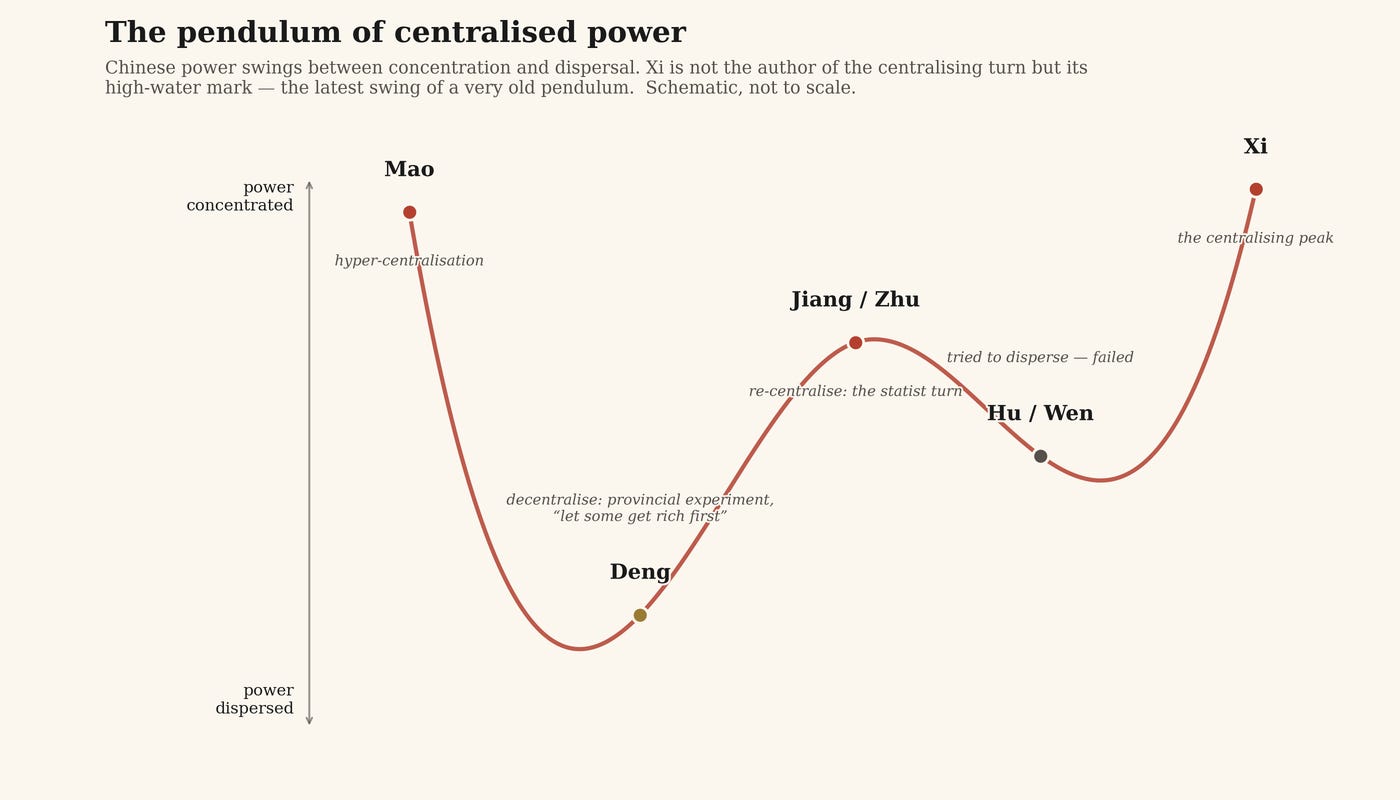
A simple schematic of the swing between concentrated and dispersed power, Mao to Deng to Jiang/Zhu to Hu/Wen to Xi.
The instability at the top
Why does the pendulum swing back toward the centre so reliably, and why does it defeat those who try to hold it at the decentralised end? Probably the most rigorous answer comes from the late Joseph Fewsmith, who was professor of international relations at Boston University’s Pardee School.
The conventional wisdom Fewsmith addressed had been reassuring. It held that China had solved the problem that destroys most authoritarian regimes: the orderly transfer of power. After Mao’s chaos, the Party was said to have built rules that made succession predictable and the system stable. These included term limits for senior leaders, age ceilings, an apparent meritocracy of promotion, and the smooth handover from Jiang Zemin to Hu Jintao. Andrew Nathan, whom we will come to, gave this view its name two decades ago: authoritarian resilience.
In *Rethinking Chinese Politics* Fewsmith took that consensus apart. Tracing four decades of elite politics from Deng to Xi, he argued that Chinese politics at the top are not institutionalised at all. As in every Leninist system, power cannot be cleanly passed from one leader to the next, because there is no neutral mechanism that confers it. Each new leader must build his own power from scratch, seizing critical positions, installing protégés, sidelining rivals, twisting or violating the very rules that are supposed to bind him. The handover from Jiang to Hu that looked so smooth was, in Fewsmith’s reading, neither smooth nor institutionalised: Jiang’s influence lingered for years, and the Hu period that followed was not a settled order but a vacuum, a leader without a secure core, factional competition running unchecked beneath him.
Here the author must add a personal anecdote. I was managing editor of the South China Morning Post in the years of the handover from Jiang to Hu, working closely with the China desk under Wang Xiangwei, who went on to become the paper’s editor in chief. I saw up close how unstable the Hu years were because the institutions of power were weak. Most notable of these was the lack of a mechanism forcing Jiang to hand over the chairmanship of the Central Military Commission at the same time as stepping down as president and Party leader. It only happened two years later. Thus, when it was time for the handover from Hu to Xi in 2012, it came as little surprise to see how Xi insisted on taking the CMC chair position at the same time as the other titles. But I can also recall the widespread speculation among analysts at the time that Xi had been forced to engage in some extreme brinkmanship in order to get that.
In any case, the weakness of the Hu decade clearly invited what came next. Fewsmith’s verdict on Xi is that he has extended this model of personal dominance to a new extreme, purging rivals, promoting loyalists, taking personal control of the army. The point for this series is not that Xi is unusually power-hungry. It is that the system gave him no other way to rule. A Leninist order that cannot institutionalise succession is an order that periodically requires a strongman to gather the pieces back together, because the alternative is the drift and faction of a centre that has lost its grip. The recentralisation is not a personality. It is a structural necessity, built into a system that never solved the problem of how power passes on.
That is why the pendulum swings back. Dispersal, in this system, does not stabilise into a settled federalism of provinces and institutions. It decays into the factional weakness of the late Hu years, and that weakness summons the next consolidator. The reformers who tried to hold power at the loosened end were not defeated by Xi. They were defeated by the structure that made a figure like Xi necessary.
The fracture that made a strongman
It is worth pausing on how real that weakness had become by the time Xi took power, because the centralisation he is criticised for looks different once the alternative is clear. In the months before Xi’s ascension at the 18th Party Congress in November 2012, the Party gave the world a startling glimpse of its own fracturing, in the affair that brought down Bo Xilai.
Bo was the charismatic Party secretary of Chongqing, a Politburo member and a leading contender for a position on the Standing Committee. Like Xi, he was a princeling, and many had seen him as holding a higher position in the aristocratic pecking order as the son of one of China’s “Eight Immortals”, Bo Yibo. The story of how Bo challenged Xi’s anointment as Hu’s successor is told at length in *A Death in the Lucky Holiday Hotel* by the journalist Wenguang Huang and his co-author Pin Ho.
Its central scene is extraordinary. In February 2012 Bo’s police chief, Wang Lijun, fearing for his life after confronting Bo with evidence that Bo’s wife had murdered a British businessman, fled to the American consulate in Chengdu and asked for refuge. Bo’s own security forces, dozens of carloads of armed police, pursued him across the provincial boundary and surrounded the consulate. A regional Party baron’s private army was laying siege to United States diplomatic soil, and the standoff ended only when Beijing intervened over Bo’s head, ordering the Chongqing forces to stand down and dispatching a vice-minister of state security to take Wang away. In the weeks that followed, rumours of a coup plot involving Bo and the security chief Zhou Yongkang, and even of gunfire in Beijing, spread widely enough that the state felt compelled to deny them.
That the rumours were believed at all is the point. Here was a senior leader running a personal fiefdom, commanding forces loyal to him rather than to the centre, entangled in murder and defection, and plausibly imagined as the hub of a conspiracy against the incoming leadership, all on the eve of a succession. One assessment called it the gravest political crisis since Tiananmen. Read against that, Xi’s subsequent campaign against corruption and factional power centres is not simply a power grab, though it served his power. It was the centre reasserting control over a system that had visibly begun to come apart, the pendulum swinging back because the dispersed end had decayed into exactly the factionalism the structure cannot tolerate for long. The Party, long united, was dividing again, and it answered as it always has: with a strongman.
The drive the instinct serves
If Fewsmith explains the mechanism (or lack thereof) by which power transfers in China, he does not, on his own, explain the purpose. A system can require strongman consolidation and still be asked: consolidation in the service of what? Here the argument has to reach back further, past the People’s Republic, into the deeper history the Party draws on for its sense of mission.
One of the most useful guides is Orville Schell, the long-time director of the Center on US-China Relations at the Asia Society, who with John Delury wrote Wealth and Power: China’s Long March to the Twenty-First Century. Their organising idea is an old phrase, fuqiang — wealth and power. This is the compressed slogan of a group of people who can best be called “self-strengtheners”. From the Opium Wars onward, a series of remarkable historical figures asked how China could recover its greatness after the century of humiliation at foreign hands. They were striking a deep chord. The drive to make the nation rich and strong, so that it could never again be carved up and dictated to, undoubtedly runs as a single thread through every modern Chinese regime, however else they differed: the late Qing reformers, the Nationalists, Mao, Deng, and now Xi. It is the constant beneath the changing ideologies.
The relevance to our series of essays on the politics of Chinese economics is direct. The suppressed-consumption, surplus-generating economic model that our economics trilogy described is fuqiang in economic form. Households are squeezed and the surplus directed to industry, infrastructure and the state, not as an accident of policy but in the service of national strength. A model that maximised household consumption would make the population more comfortable and the nation, by this logic, weaker, its resources dispersed into a hundred million shopping baskets rather than concentrated where the state can wield them. The choice our economics series could not explain — why the solution to China’s economic challenges is so consistently declined by the Party leadership — begins to make sense once the goal is understood not as the people’s prosperity but as the nation’s power. The centralised control that Fewsmith’s system requires is control for something, and the something is fuqiang.
The insecurity beneath the drive
There is one more layer, and it sits beneath even the drive for wealth and power. Why is fuqiang so insatiable, never satisfied by any amount of success? The answer this series finds most persuasive comes from Andrew Nathan, the Columbia political scientist who, with Andrew Scobell, wrote China’s Search for Security. Their thesis is that China, for all its size and rising strength, sees itself as a vulnerable nation surrounded by powerful rivals, ringed by threats at every distance: at home, among its immediate neighbours, across the wider region, and in the world beyond. The state that looks to outsiders like a confident rising power experiences itself, from the inside, as perpetually exposed.
This reading is contested, admittedly. Many analysts read China’s conduct in the South China Sea, across the Taiwan Strait and along the Indian border as expansion, not defence. They are not simply wrong to do so. But Nathan and Scobell’s point is about the perception that drives policy, whatever its outward effect, and that perception is one of vulnerability. The conclusion they draw is that China is, in their phrase, too bogged down in the security challenges within and around its borders to threaten the global order unless the dominant powers holding up that order weaken themselves first. The relentless drive for wealth and power, on this account, rests on something older and more anxious: a chronic insecurity that no amount of material success has ever managed to quiet.
Stack the three together and the structure of this argument is complete. The insecurity (Nathan) feeds the drive for national strength (Schell); the drive requires a state that can concentrate resources and will (the fuqiang model); and concentrating them requires the recentralised, personalised control that the system, unable to institutionalise power, periodically demands (Fewsmith). Each layer rests on the one below. And at every level the answer to the question of whose interest comes first — the Party’s cohesion and the nation’s strength, or the welfare of the people — comes out the same way. It always has. The people’s comfort is the thing surrendered, again and again, because in a system built on insecurity and the pursuit of strength, a contented but dispersed population is not the goal. A strong and unified state is.
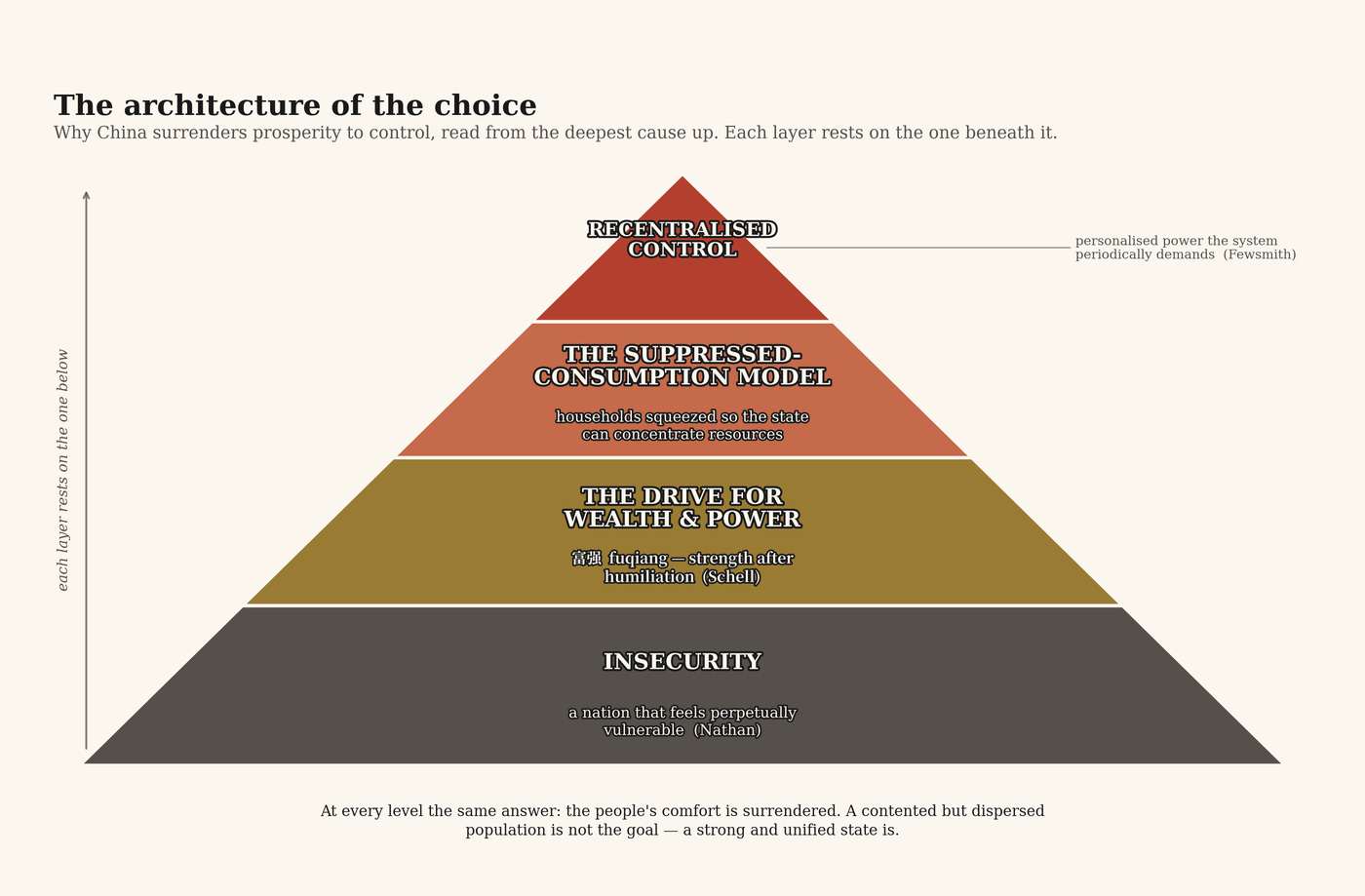
The nested structure of the argument, from the deepest cause up: insecurity (Nathan) beneath the drive for wealth and power (Schell), beneath the suppressed-consumption model, beneath the recentralised control the system demands (Fewsmith). Each layer rests on the one below.)
The seed in the cycle
This is a bleak structure, and it would be a bleak place to end. But the cycle that explains the Party’s choices also contains the ground for a different reading, and this series will return to it at the close, in Part 6. If centralised power moves in a rhythm, then the current concentration is not the end of history. It is a phase, and the old wisdom is explicit about what follows a long concentration: long united, must divide. Over-centralisation, on the logic of the cycle itself, is self-limiting. The very intensity of the present swing is, on this reading, evidence that it could be near its peak.
That is a hope, not yet an argument. What can be said now is narrower. The recentralising instinct that subverts the adoption of an economic solution that is widely considered to be in the country’s best interest is not necessarily a free choice that a wiser leader would make differently. It is more likely the latest turn of a structure with deep foundations: a Leninist system that cannot pass power on safely, a civilisational drive for strength after humiliation, and an insecurity older than both. The man was never the answer. Neither, quite, is the system on its own. The next question is whether the machine beneath the leader could deliver the solution even if it were ordered to. The answer, as the next essay will show, is no.
Next in the series, Part 3: Moving the machine: a Sisyphean task. Even if Beijing decided to turn the economy toward households tomorrow, the bureaucracy beneath the decision would struggle to deliver it. We draw on Xiao Ma on the attention economy that rewards the visible over the useful; Ning Leng on the visibility trap that builds the tower and skimps on the pipes; Andrew Batson of Gavekal Dragonomics on why a leadership that speaks in slogans leaves its own cadres unable to act; and Michael Pettis of Peking University on why the household transfer is the one thing the model cannot concede.
Dragonometry draws on a wide range of open-source news and analysis. All external sources are linked directly. Claude.ai assisted in the production of this publication, but views and analysis (and errors) are the author’s own.
It is notewothy that, as have always been the case in Chinese history, the last stronghold of independece from the center is in Sichuan and that the final success of a centralizing force is catalyzed by its final conquest . It seems like we have witnessed the times of the Shu kindgom, of Chang Hsien-chung or Shin Ta-kai.
In the "Essay on Chinese Geography" of 1934 Liang Ch'i-ch'ao wrote "every time that there had been disorder under heaven, the Sichuan was help by an independent governor and he was always the last to lose its independece."
Might I suggest a fourth layer borrowed from a recent China Thought Express post featuring the work of philosopher Liu Xiaoguan? Essentially a classical argument that China is unable to settle on any political middle ground.
https://substack.com/@1234458676/note/p-205822831?utm_source=notes-share-action&r=5hihj4