
Moving the machine: a Sisyphean task
Part 3 of our series on the politics of China’s economics: Even if Beijing decided tomorrow to turn the economy toward households, the bureaucracy would struggle to deliver.

TO RECAP: Part 1 of this series argued that the household-suppressing growth model is not Xi Jinping’s invention and it is better to look at systemic reasons for it; Part 2 explained why China’s system reliably chooses control over prosperity. Both were about why the Party will not administer the necessary economic solution. This essay and the one after it ask a different question: whether the bureaucratic machine beneath the leadership could carry it out.
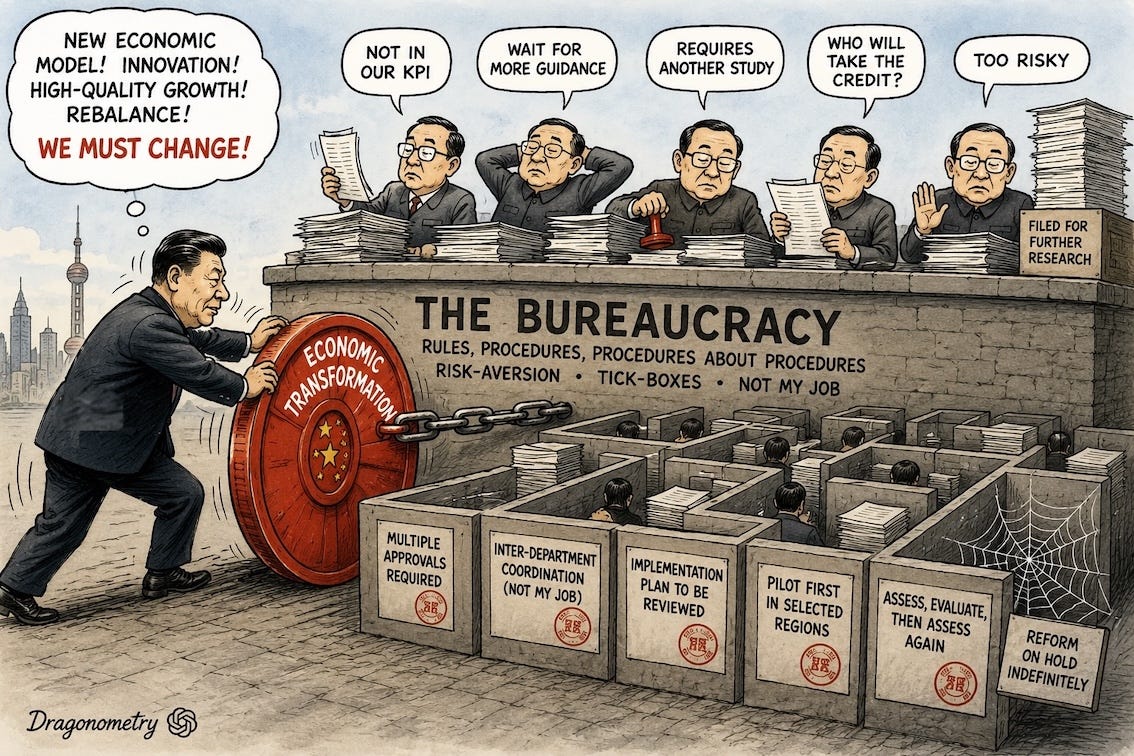
GRANT, FOR THE SAKE OF ARGUMENT, everything the optimists want. Suppose President Xi Jinping woke tomorrow persuaded that the country’s export-oriented economic model has run its course, that the 2049 Chinese Dream of national rejuvenation is in jeopardy if households stay suppressed, and that the way out is the one named by every serious economist: raise incomes, build the safety net, let consumption carry the load. Suppose, in other words, that the political will this series has spent two essays explaining were simply to manifest. Would the turnaround of the Chinese economy then happen?
Not so easily, is the short answer, and likely not at the scale required.
Such an assertion might come as a surprise to many analysts of the Chinese political economy. Or at least those impressed by Beijing’s ability to set ambitious five-year plans and mobilise a vast civil service in pursuit of long-term goals. What this tends to overlook is how that machine has been built, and how difficult it is to manage. It rewards only certain kinds of work; it hears some instructions loud and clear and goes deaf to others. The demand-side solution for China’s economic challenges, it turns out, requires the kind of effort this machine was not designed for. In fact, it is the kind it was built to starve.
Why the transfers are necessary
Before turning to the mechanics of the system it is worth pausing to reflect on why the household-consumption solution is such a demanding one, because there are those who say it is not. They contend that China’s surplus is simply the by-product of superior efficiency: it makes things well and cheaply, the world buys them, and the trade surplus follows. If that were the case, rebalancing would be easy, just a matter of letting wages and the currency rise as the economy matures.
Michael Pettis, the Peking University finance professor whose framework we lean on, offers the cleanest test of that claim. If the surplus were pure efficiency, China could raise household incomes, strengthen the safety net, let interest rates and the currency rise toward their market levels, and still out-compete the world on its merits. Why? Because efficiency does not evaporate when workers are paid more. But China has not done these things, and shows no intention of doing them at scale. Why not? Because the suppression of household income is not an incidental feature of China’s development model but a pillar of it: the transfer of resources from households to producers and the state is what generates the country’s surplus. Removing it means dismantling the growth engine itself. That is what the leader would be ordering, and it is why the bureaucracy’s response matters so much to considerations of how effectively it could be carried out.
Not built for that
For a rigorous account of how the Party’s machinery distributes its energies, we are grateful to be able to turn to a newly released book. Xiao Ma, an Associate Professor of Political Science at Peking University, sets out in Rethinking Political Meritocracy, a study published by Cambridge in 2026, what he calls an attention-based account of Chinese officialdom. It goes a level deeper than the familiar story of cadres chasing growth targets.
Ma draws a distinction between two types of officials. There are the territorial leaders, the kuai, who run a place — a county, a city, a province — and whose performance shows up in visible, comparable numbers. And there are the functional-department leaders, the tiao, who run a domain — public health, social insurance, environmental regulation — cutting vertically across the territorial structure. Ma’s insight is that the two are not evaluated the same way; nor can they be. The territorial official’s record can be measured and ranked: growth, investment, a skyline. The functional official’s contribution is far harder to observe, attribute or compare. How do you rank the competence of a provincial social-security administrator against his peers? The outcome is diffuse, slow, shared across agencies, and invisible in any photograph.
From this asymmetry Ma builds his central claim. In a bureaucracy this large and this opaque, the scarce resource is not effort or even competence but the attention of one’s superiors. Careers advance when an official captures that attention, and the surest way to capture it is a visible, legible, attributable achievement. The trouble, as Ma documents, is that not all attention-seeking serves the goals of good government. It tilts the whole system toward formalism and over-implementation, toward whatever can be seen and counted, and away from the patient functional work that cannot.
This carries a direct implication for the household-consumption solution to China’s economic challenges. Turning the economy toward a consumer-led model is tiao work. It is the building of a pension system, the deepening of health insurance, the unglamorous plumbing of boosting household security. It involves spreading the benefit of provisions across a hundred million lives and a decade of time. And it can never be pointed to as one official’s achievement. It is the least legible, least attributable, least attention-catching work the state can undertake. A machine designed to promote cadres on captured attention will not likely do such work well, whoever gives the order, if doing it well earns no one anything that can be seen and rated.
This nests on an argument we have made previously in this series. Ning Leng, the Georgetown political scientist, calls the surface expression of it the visibility trap: because officials are judged from above rather than by the citizens who use what they build, they build the visible — the tower, the showcase plant — and skimp on the pipes beneath it that would make it work. We have traced that trap from the country’s ghost cities to its solar-panel graveyards, and watched it appear in each new priority sector named by Beijing. Ma supplies the deeper why. The system that resulted in rows and rows of empty apartment towers would actively work against the provision of a more robust social-security net, because it would take resources away from the projects that get officials promoted. Control is not only an instinct at the top of the system. It is wired into the promotion incentive of every official below it.
Many yards, high fences
If the challenge were only one of unblocking that vertical channel, it might be easier to hold onto the optimist’s argument that Beijing is already on the right track. It is certainly aware of the problem. Analysts at RAND, tracing the country’s techno-industrial strategy, describe how central reforms cascaded downward until provinces and cities had built sprawling ecosystems of development zones, financing vehicles and local bureaus. The result was rapid expansion, but also duplication and protectionism. Beijing’s institutional reforms since 2018, on this reading, were designed to rein in that sprawl and pull authority back to the centre.
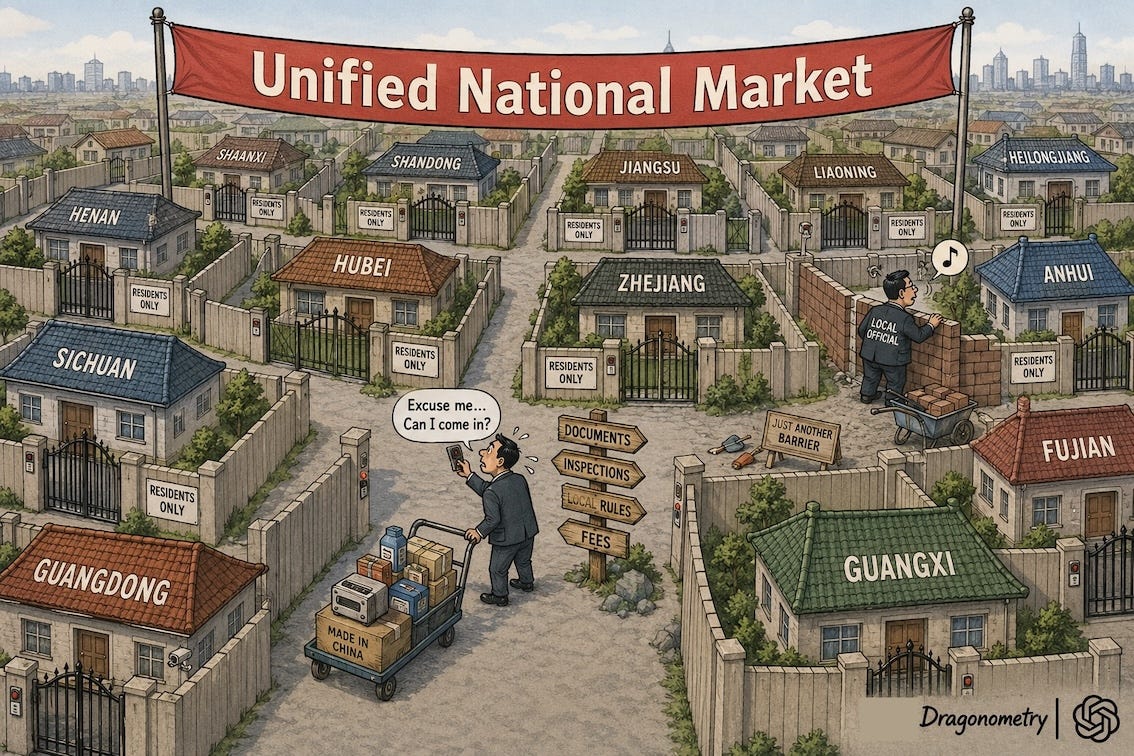
But there is a second blockage, running the other way, and it is the more intractable of the two. Alongside the vertical problem of getting an order down through the ranks sits a horizontal one: the country’s own internal market is not one market at all.
The problem is easy to state and, for a country as centralised as China, it can come across as almost absurd. The world’s most powerful single-party state does not have a single domestic market. Alexander Davey, an analyst at the Mercator Institute for China Studies, the Berlin think tank whose independence Beijing acknowledged by sanctioning it, describes a country left as a jumble of dozens of provincial markets and hundreds of local ones: an economic patchwork at odds with a unitary political system. Provinces and cities shield their own firms from outsiders through local favouritism in procurement, refusal to recognise licences and professional qualifications earned elsewhere, and restrictions that make it harder for a non-local company to get capital, land, energy or data on the terms a local one enjoys.
The consequence ought to stop any reader of our economics series in their tracks. Chinese businesses have often found it easier to expand overseas than to compete in the province next door. The export machine is not only a product of suppressed domestic demand. It is also a product of a domestic market too fragmented to sell into.
Beijing knows all this, and has said so for years, at the highest levels the system possesses. Xi Jinping raised the problem after coming to power in 2012. In April 2022 the Party’s Central Committee and the State Council jointly issued a landmark guideline making a unified national market a top-level priority, and the economic planning agency followed with detailed rules instructing every locality and department to accelerate their integration into it. In October 2025 the Party’s own Central Committee pledged to eliminate local protectionism and market segmentation, and to ensure the underlying rules of the market were the same across the country. The 15th Five-Year Plan instructs every level of government to remove the bottlenecks and obstacles standing in the way. Since 2025, Xi has been promoting the slogan of the five unifiers and one opening up, signalling an intent to unify not only the market but the legal, fiscal, technological and regulatory systems that sit beneath it.
This is not the machine losing its way in the fog of national greatness, which we come to below. It is about as clear an instruction as a Leninist state can issue, restated for fourteen years.
And it has not happened. In June, Davey published a second piece for the institute, a survey of what Chinese scholars themselves are saying about the problem. Its verdict on fourteen years of instruction was dry: progress has been slow.
The question of why is, again, less confounding once it is understood that the incentives driving this behaviour are difficult to legislate away. The local official is promoted on local growth. A firm inside his jurisdiction generates the tax receipts, the employment, the visible output that shows up in his record; a competitor from the next province generates none of it, and may even destroy some of his. Dismantling the barrier between them would be an act of national efficiency that registers, on the metric that governs his career, as pure loss. He is not defying Beijing. He is doing what the system has steered him to do through the way he is rewarded and promoted.
Most remarkable is that some of China’s own top scholars say this out loud. The Chinese experts whose arguments Davey surveys do not call for more directives, because directives have been tried. They call instead for a change to the way cadres are evaluated: stop promoting officials on short-term local growth, and weight their records toward fair markets and national integration. The survey’s conclusion is one this series could have written. If Beijing fails to stop rewarding local cadres for boosting local growth and protecting local interests, China will continue to struggle to build a single market. The diagnosis inside the tent is the same as ours. The incentive is the obstacle.
Again, however, this is not a matter of changing a few rules and exhorting the cadres to behave better once they have been told they will be judged differently. There is another reason the provinces cling so fiercely to their local champions and their local tax bases, which cannot be fixed by adjusting career incentives. It is that they cannot afford to let go. That is a story about money, and it is the subject of the essay after this one.
A dream is not a target
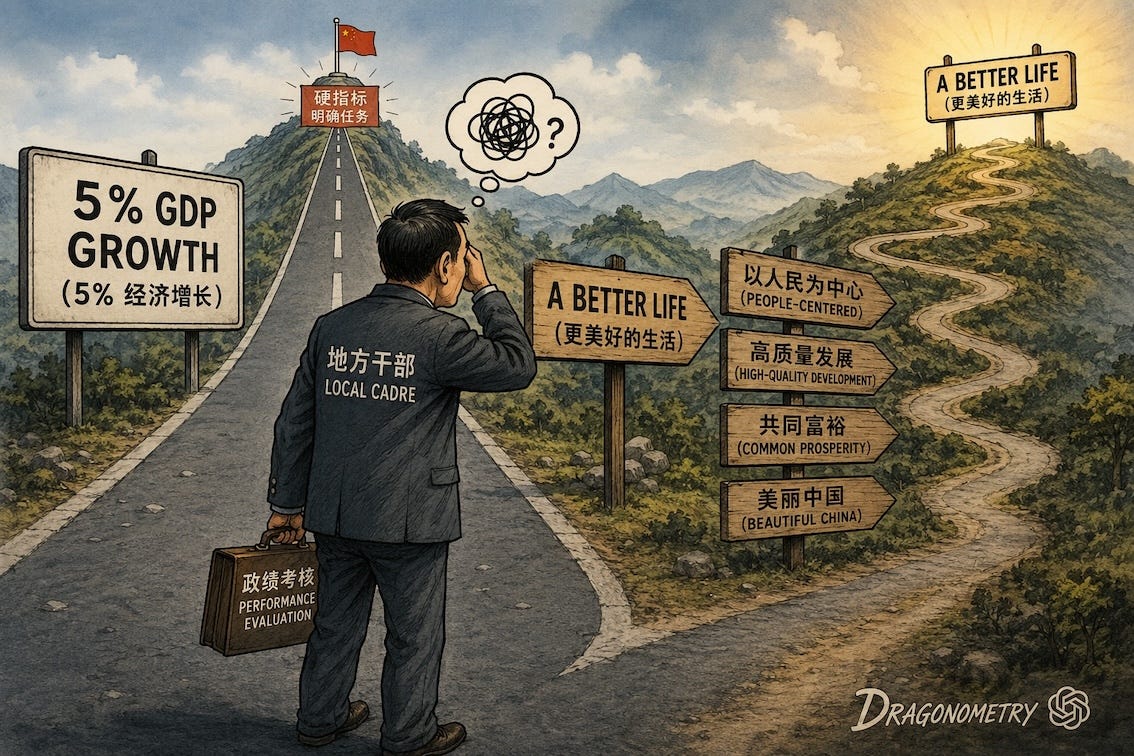
Those are the obstacles to implementing an order to reshape China’s economic growth model. Hard enough though they are, they do not even consider the question that ought to precede them: how would the centre actually communicate what it wants from the periphery? Suppose the order to rebalance were given, clearly and with full authority. Is the machine capable of understanding it?
This is where the work of Andrew Batson comes into focus. The China research director at Gavekal Dragonomics has written with unusual clarity about how instruction travels through the Chinese system. His starting model is simple: the Party leadership sets a clear goal toward which the nation is to strive, and cadres throughout the state and society mobilise to achieve it. Given a clear, simple direction, the machine is indeed formidable. For nearly four decades that direction was economic growth, and it worked: the mobilisation behind it built the fastest sustained expansion of any major economy in modern history. When the signal is unambiguous, the Chinese state is one of the most effective instruments of mobilisation the world has seen.
Then, at the 19th Party Congress in 2017, Xi Jinping did something bold. He declared, in the most formal and public setting the system affords, that growth would no longer be the goal the nation mobilised toward. Judged on its own terms this was defensible, even overdue: growth-at-all-costs had bought its expansion at a price in debt, pollution and waste that the country was still paying. But what was offered in its place was not another clear target. It was a promise of a better life for the people. Batson, discussing the new synthesis on the CSIS Pekingology podcast, has been blunt about what that did to the machine: a slogan so vague, even by the standards of Party slogans, that it offered cadres no coherent guidance on what they were actually meant to do. Having removed the old goal, the leadership did not supply a new one that could be acted on. It introduced, in his phrase, a profound instability into the system.
Call it a signal-transmission failure. But it is more than that, because it compounds the incentive problem built into the Party machine rather than merely sitting beside it. A system built to mobilise behind a legible target is handed a target that is not legible. What is it to do?
It falls back on what it knows. This is what Xi himself complained about in a speech to the Central Party School on 1 March 2022, published by official media more than a year later. It is all the more revealing for being ostensibly about ethics and cadre responsibility rather than economics. Most cadres could adapt, he said, but some could not keep up: they still thought development meant launching projects, making investments and expanding scale, and some still reached for the polluting, energy-hungry ventures of the old playbook. Batson’s reading of that grumble is the one we would offer. The cadres were not being obtuse. They were doing the rational thing when an instruction is unclear, which is to fall back on the last instruction that was clear.
Again, this is such an important point that it bears repeating. The turn to a new economic model driven by household consumption rather than investment and exports requires not only that the Party machine be able and willing to do the necessary work but that it receive an unambiguous order to do it. The current ideological register of the Party leadership does not deal in unambiguous economic orders. It deals in umbrella concepts of national greatness, under which a hundred contradictory readings can shelter.
There is a revealing consistency here with the argument of Part 2 in our series. Batson himself reaches for Joseph Fewsmith’s Rethinking Chinese Politics, the book we referenced in that essay, to explain what Xi is doing. Xi’s real objection to the decentralised growth model championed by his predecessors, on this reading, is not that it was economically inefficient but that it eroded Party discipline and bred corruption and local autonomy: growth-at-all-costs had a political cost the centre could no longer bear. Xi’s centralising turn is best understood, Fewsmith argues, as an attempt to reinvigorate Leninism, to pull a dispersing system back under Party control. The fuzziness of the new economic signal is not a communications failure to be fixed with a clearer memo. It is illustrative of the fact that the leadership’s true priority was never the economic goal in the first place. The message is vague on the economy because the economy is not the priority. Control is.
What is left standing
Put the incentives and the communications together and a hard conclusion emerges before we have even reached the question of money. A machine that cannot reward a turn toward household consumption, because the work is invisible to the attention economy that runs it, and cannot clearly hear the order to pursue it, because the leadership speaks in the fog of national greatness rather than the plain language of economic instruction, is a machine that would struggle to deliver the necessary economic rebalancing even if the will at the top were wholehearted. The optimists’ fondest premise, that the problem is simply Xi’s reluctance, which would dissolve the moment he changed his mind, does not survive contact with the bureaucracy. He could change his mind tomorrow, and the machine would still battle to turn.
Having laid that out, it provides no satisfaction to acknowledge that it is all actually quite futile to consider, because of the third and most important reason why it would be so difficult to change China’s economic model. Even a machine that wanted to build the safety net, and clearly understood that it had been told to, would run into the question of who pays for it. The structure of Chinese public finance, the split between a centre that collects the revenue and localities that bear the spending, turns out to make the solution not merely unrewarded and unclear but increasingly unaffordable. That is the third and most daunting challenge, and the subject of the next essay.
Next in the series, Part 4: What to do when the fiscal taps run dry. The most concrete obstacle of all to turning the economy around is money. We draw on Arthur Kroeber of Gavekal Dragonomics on the 1994 settlement that handed the revenue to the centre and the spending to the localities; the Rhodium Group on why a wholesale fiscal overhaul is unavoidable and nowhere in sight; and Gerard DiPippo of RAND on how Beijing pushes the cost of its priorities downward. We also look at what the wreckage of the special-purpose bond looks like up close. Look out for it.
Dragonometry draws on a wide range of open-source news and analysis. All external sources are linked directly. Claude.ai assisted in the production of this publication, but views and analysis (and errors) are the author’s own.